A Manifesto
What if the most important invention of the century is being built in someone's garage right now?
Listen to the manifesto
The 100th Monkey
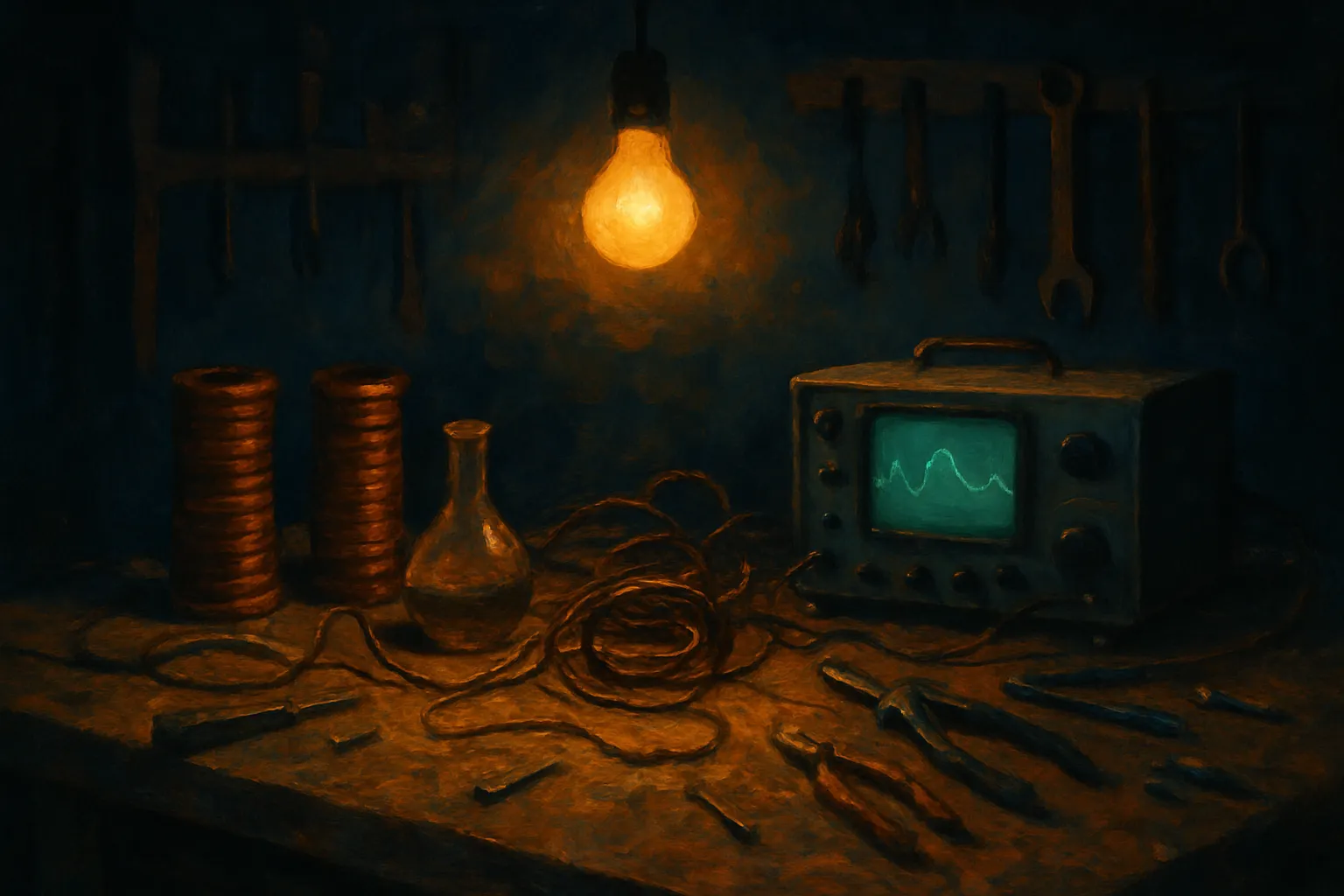
Built after hours, on a workbench.
The most important invention of the century may not come from a lab with a budget. Read 768 energy patents closely and the same few mechanisms keep recurring — reached independently by people who never cited each other.
Different inventors, decades and continents apart, with no shared citations — converging on the same handful of mechanisms.
That convergence is either the biggest fluke in engineering history, or it’s pointing at something real. We think it’s a signal.
Breakthroughs follow a pattern: someone builds it, then it quietly disappears. Open Energy is the refusal to let that happen again.
There are 768 publicly available patents describing devices that claim unusual energy efficiency. Electromagnetic, electrochemical, solid-state, plasma, thermodynamic, LENR. Different inventors, different decades, different countries. Read the claims closely and a handful of mechanisms keep recurring — reached independently by people who never cited each other:
Vacuum fluctuations, rectified into current. Water, split at resonance. A collapsing magnetic field, caught and fed back. Hydrogen, loaded into metal until it runs hot.
That convergence — the same few templates, arrived at decades and continents apart with no shared citations — is either the biggest coincidence in the history of engineering, or it's a signal. We think it's a signal.
The problem with breakthroughs
History has a pattern. Someone builds something remarkable in a workshop. It works. They file a patent. And then — depending on who you ask — the device is quietly acquired, the patent is classified, or the inventor is offered a choice between silence and trouble.
You can dismiss that as conspiracy. Plenty of people do. But the US Patent Office has a well-documented secrecy order process under the Invention Secrecy Act of 1951. Thousands of patents are under active secrecy orders right now — the exact number is published annually. The program is not hidden. The criteria are.
We don't know which energy patents have been sequestered. We don't know how many garage-lab breakthroughs have been quietly shelved. But we know the pattern exists. And we know that patents, by design, centralize knowledge in the hands of whoever files first.
So we're trying something different.
The 100th monkey
There's a story — part science, part fable — about monkeys on a Japanese island who learned to wash sweet potatoes. One monkey figured it out. Then a few. Then dozens. And then, supposedly, once the number crossed some critical threshold, monkeys on other islands who had never seen the behavior started doing it too.
The literal science is debatable. The metaphor isn't. Ideas have a tipping point. When enough people understand something — really understand it, hands-on, in their own garages and classrooms and maker spaces — that knowledge becomes impossible to contain.
You can classify a patent. You can't classify ten thousand people who already built the thing.
What we're actually building
HiveJournal's Open Energy project is a participatory science platform. We took those 768 patents, read them by mechanism instead of by keyword, and grouped them into six convergence clusters — the templates unrelated inventors keep reaching. From those we distilled hands-on experiments that anyone with basic electronics equipment can replicate, each built to confirm or falsify one claim as cheaply as possible.
Each experiment is a structured template. You clone it, follow the procedure, record your measurements, and publish the results — confirmed or refuted, either is valuable. When 50 independent people confirm the same anomalous result, that's not anecdote anymore. That's data.
Around those experiments, we built the infrastructure for a global community:
- ▸A world map of citizen scientists, family teams, classrooms, and meetup groups
- ▸An annual Open Energy Competition with a public leaderboard
- ▸A sponsors program connecting companies with individual researchers
- ▸Internships, scholarships, and fellowships posted by backers
- ▸Local meetup groups where people build things together in person
- ▸Classroom-safe experiment tracks for K-12 teachers (no student data, ever)
- ▸Video build logs so people can watch each other work
All of this is free. All of it is open. There are no paywalls on the experiments. There are no patents on the platform. The code is version-controlled. The data is public. The results are published whether they confirm or refute.
The part no one says out loud
Everyone is looking for a way out.
Out of energy bills that climb every year. Out of supply chains controlled by a handful of companies. Out of a system where the physics of your lightbulb is dictated by the economics of someone else's quarterly earnings.
We don't know if the convergence buried in those 768 patents leads to a real breakthrough. We suspect it does. But even if we're wrong about the physics, we're not wrong about the method: get enough people building, measuring, and sharing, and the answers surface whether institutions want them to or not.
When you get past 20 percent efficiency — don't patent it. Share it.
Put the build log on the internet. Film the measurement. Upload the schematic. Let a thousand garages replicate it before anyone can make it disappear.
That's the thesis. That's the bet. The 100th monkey doesn't need permission. Neither does the 100th Hum.
Build your Hum
We call it The Hum — a personal energy device small enough to sit on a shelf, simple enough to build in a garage, and open enough that no one can make it disappear. It doesn't exist yet. We're assembling the knowledge to build it, one confirmed experiment at a time.
If you have a garage, a bench, a classroom, a maker space, or just a stubborn curiosity about how energy actually works — there's a place for you here.
Inspired in part by The Why Files — specifically the bit at the end where AJ and Hecklefish talk about weekend tinkerers and the idea that some things are too important to patent. We agree.