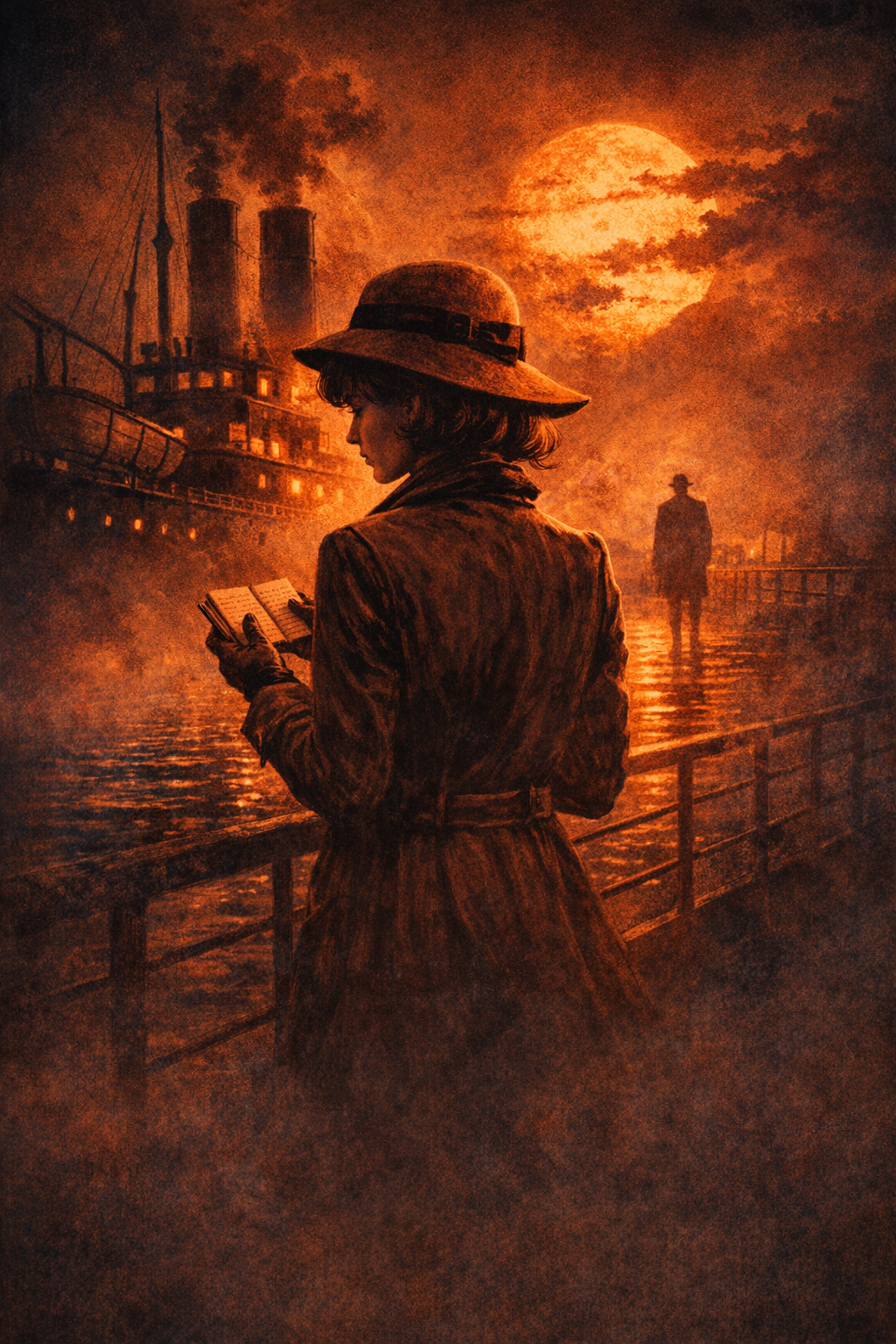
Echoes of Ambition
The crane operator was shouting something in Flemish that nobody on the quay bothered to translate, and the steel crate he was swinging over the Antwerp dock traced a slow, groaning arc through the salt-grey afternoon. Underneath it stood a man in a dark overcoat with his hands clasped behind his back. He did not look up. He watched the shadow of the crate move across the cobbles instead, as though the shadow were the more interesting problem.
This was Rudolf Diesel. Fifty-five years old. Inventor of the engine that bore his name. In the spring, he had refused the Bessemer Medal without public explanation, and in the months since, the people who kept track of such things had begun to keep track of him more closely. He had not been sleeping. You could see it in the way he held his jaw. A man rations his face when he hasn't slept, spends it carefully, and Diesel today looked bankrupt. Beside him stood an older man, broader, better fed, in a hat that suggested the kind of standing that doesn't need to be announced. He had one hand very lightly at Diesel's elbow. Not holding. Only ready to. When the crate cleared and the dockworker whistled the all-done, it was the older man who moved first, and Diesel who followed.
Across the quay, pretending to read a timetable she had already memorized, was Clara Hartmann. Thirty-one. The Antwerp Telegraph, which is to say a paper that printed grain prices on page two. Her editor had warned her off the Diesel story twice, and she had come to the port anyway, because warnings from that particular editor had a way of describing exactly the stories worth writing. In her coat pocket, folded twice, was a café napkin.
She had taken it an hour earlier from a table at a place three streets inland, where Diesel had sat sketching with a fountain pen that leaked and had not seemed to notice the ink on his thumb. He had drawn a fuel-injection assembly, cross-sectioned, with pressures noted in the margin in a hand that got smaller and more frantic as it ran out of paper. Numbers that did not match the numbers he had published. Numbers that did not match the numbers anyone had published. When Kessler had come through the door and crossed to the table with the brisk, proprietary stride of a man retrieving his own property, Diesel had already stood to leave, and Clara had already palmed the napkin into her sleeve.
She had not yet decided what it meant. She only knew it meant something, because Kessler had reached for it before he had greeted the man who drew it. Now, at the quay, she waited for her opening and took it when Diesel's companion turned to speak with a porter. She crossed the cobbles in six strides and arrived at Diesel's shoulder with the deliberate ease of someone who intends to look invited. "Herr Diesel. Clara Hartmann, Antwerp Telegraph. Five minutes before you board." He did not turn to her. He looked at the Dresden, which lay at berth down the length of the quay, long and black and already taking on coal. "No interviews." "Your compression figures," she said, keeping her voice low and conversational, as though they were discussing the weather. "The ones you've been working to. They aren't the ones in the journals."
His head turned then. Just an inch. Enough. For a moment his face did a thing that faces do when they have been holding a particular shape for too long and are asked, without warning, to hold a different one. Then the shape returned. The jaw. The careful rationing. "No," he said again, and it was not the same no. The older man was back at his elbow now, moving him with that light not-quite-touch toward the gangway, and as they went, the companion looked at Clara over his shoulder, and the look was not the look of a handler annoyed by a reporter. It was the look of a man taking inventory. He was deciding, she realized, what she was. She let him decide.
Further down the quay, half-hidden by a stack of mail sacks, a third figure was watching the whole exchange with his hands in his pockets and his mouth set. Kessler had made it to the port after all. He was not looking at Clara. He was looking at Diesel's back, and the look he wore was the particular look of a man watching something he believes belongs to him walk toward a boat he has not been invited onto. A dockhand jostled him and muttered an apology, and Kessler said, without taking his eyes off the gangway, "He was never going to carry it alone. That was always the problem with him. A man like that always thinks he can carry it alone." The dockhand, who had not asked, moved on.
Clara watched Diesel climb. He paused once, halfway up, and put a hand on the rail, and the hand stayed there a beat longer than a steady man's hand would. Then he went on. The companion went up behind him, unhurried, and did not look back a second time, which was somehow worse than if he had. She had her own passage. Second class, booked that morning with money she did not strictly have. She would board in forty minutes. She would find her cabin, and she would sit on the narrow bunk with the napkin on her knee, and she would begin, in the small methodical way she began all things, to understand what she was holding.
The light went out of the sky by degrees. The Dresden sat at berth in the last of it, her hull slick with river damp, her length gone almost to silhouette. One porthole, somewhere above the waterline toward the stern, was lit amber. All the others were dark. Clara watched that single light a long time before she walked to the gangway herself.