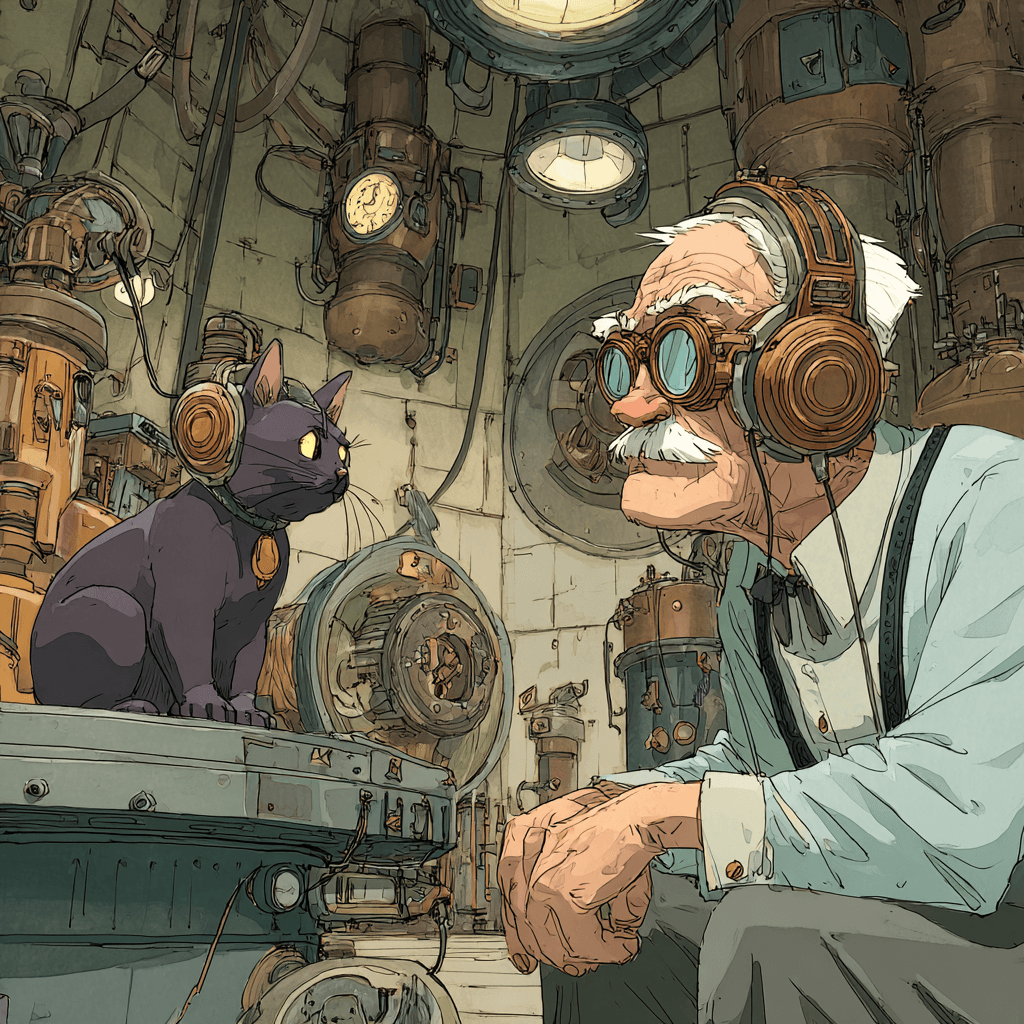
A Whisper on the Wind
The kettle had clicked off a long time ago, and Felix had let it. He sat at the kitchen table in the grey hour before sunrise, in a building that had been beige once and was beige still, on a street whose name he had practiced saying without inflection. A cup of tea steamed at his elbow. He had poured it the way a person who lived here would pour it. He had not touched it. Across the room, on the windowsill, Whiskers had stopped pacing. This was either good or bad. Felix considered it without moving his head. The cat had been circling for eleven minutes. She had paused twice, both times near the door, which was a habit he had been trying to discourage in himself as much as in her. Now she sat at the glass, tail down, watching something in the street four floors below.
He did not look at what she was watching. Not yet. Looking was a thing you could be seen doing. Instead, he picked up the pen beside the cup and signed the bottom of a utility statement that had arrived three days ago in the name on his lease. The signature was unremarkable. He had practiced that, too. He had practiced, over three years, a great many small things: how to hold a grocery bag, how to nod at a doorman, how to be a man whose face slid off the memory of anyone who passed him. He had been good at large things once. The small ones were harder. Whiskers's ears moved without the rest of her.
Felix folded the statement in thirds and carried it to the desk by the window, taking the long way, past the radiator, so that his path through the lit kitchen made geometric sense to anyone looking up from the street. He opened the second drawer. He slid the folded paper into the green folder where folded papers went. His hand stopped. At the back of the drawer, behind the folders, sat a small glass jar. It had once held something domestic, jam maybe, and now held four baby teeth, white as rice, resting against each other at the bottom. He had not opened the jar in seven years. He had not thrown it away in seven years. These two facts had achieved, over time, the quality of a single fact.
He rested his palm on the lid. The glass was cool. He did not pick it up. He did not look at it. He closed the drawer. At the window, Whiskers had not moved. Felix crossed back to the table and, because it would have been strange not to, lifted the tea and drank from it. It was the temperature of the room. He set it down. He allowed himself, then, one glance at the window, angled past Whiskers, out and up.
The tower stood where it had stood every morning. Twenty blocks east, taller than the buildings around it had any reason to permit, its upper floors washed in the soft institutional white they used at night to remind the city it was being looked after. From here it was the size of his thumbnail. He had chosen this apartment, in part, because the tower was visible from it. A person should know where the weather is coming from. Something in his jaw moved. He noticed it move. He smoothed it. "Hm," he said, and the sound was almost nothing, and Whiskers's ear flicked toward him anyway, and he understood that he had made a mistake, small but real, the kind of mistake that, accumulated, became a file. He lowered his eyes to the table.
Downstairs, on the opposite sidewalk, in the recessed doorway of a dry cleaner that did not open for another two hours, a man stood with a paper cup and the patience of someone being paid to have it. Felix had clocked him at 4:51. It was now 5:34. The man had not raised the cup to his mouth in nineteen minutes. There was a way of holding coffee you weren't drinking that gave you away, and this man had not yet learned it. He would. They sent the new ones first. The new ones were a courtesy, almost. A note slipped under the door: we are still here, we are still watching, please continue to be no one. He had been no one for three years and one month. He intended to be no one for as long as it took. Whiskers turned her head.
She dropped from the sill in a single soundless motion, crossed the floor without hurry, and stepped up into his lap. She did not knead. She did not circle. She settled, facing the window, and went still in the particular way she had, which was not the stillness of a sleeping animal but the stillness of something listening on a frequency he could not hear. He rested two fingers on her back. Her ribs moved, slow, even. Outside, the sky had not yet committed to being blue. The tower's white lights held. The man in the doorway lifted his cup at last, and lowered it without drinking, and Felix, who had trained himself out of most things, did not look away fast enough to pretend he had not been looking.
The tea on the table had gone cold. He left it there. He sat with the cat in his lap and the drawer closed behind him and the window in front of him, and he waited, the way he had taught himself to wait, for whatever was about to begin to declare itself. Whiskers, in his lap, had already heard it.