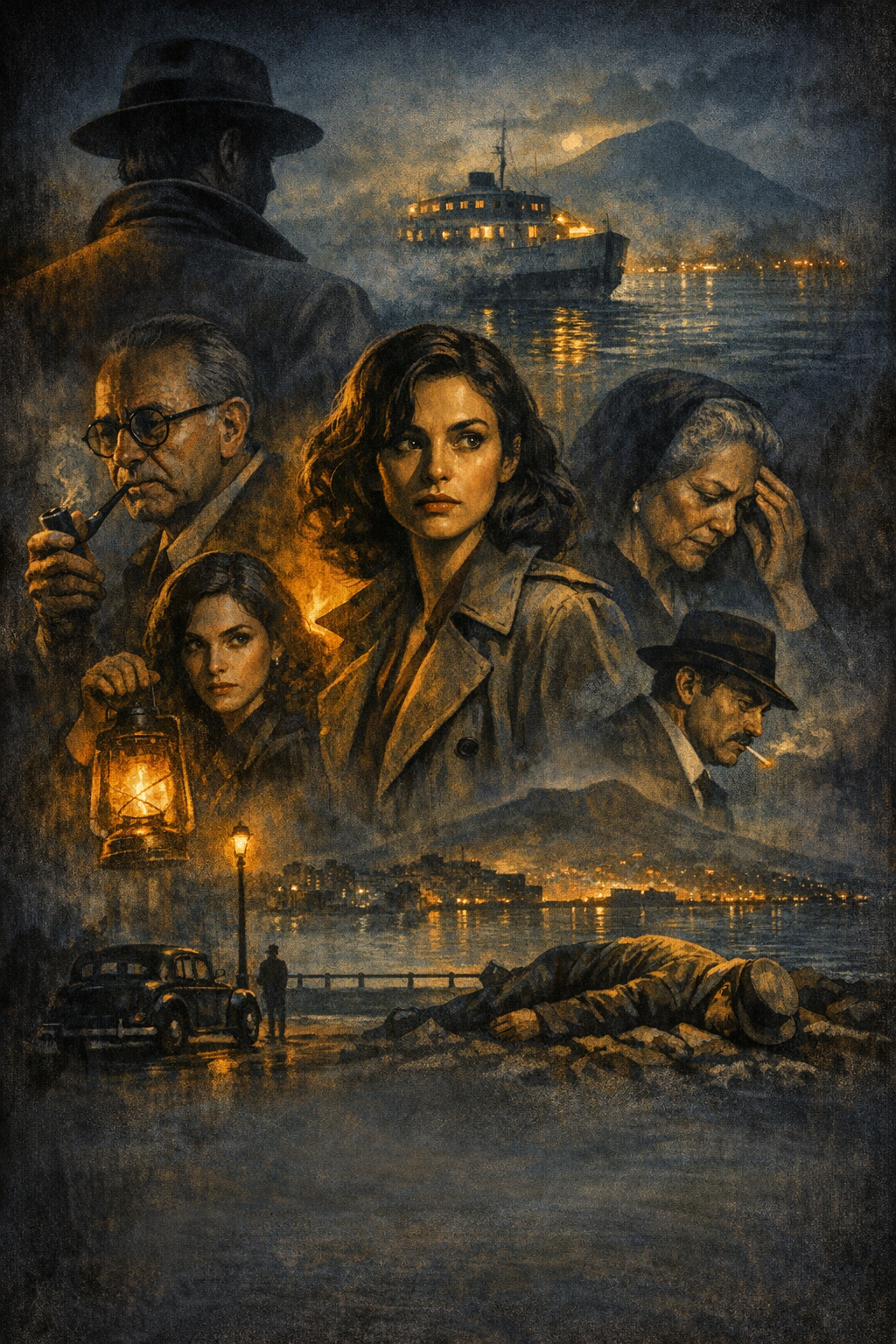
The Last Equation
He had been standing at the corkboard for the better part of an hour, and the decision he was making was not whether to take the page down. He had decided that already. The decision was whether to look at it once more before he did. He did not. He unpinned the four corners in the order he always unpinned things, upper left, upper right, lower right, lower left, and the sheet came away stiff with the memory of its own flatness. He folded it once, along a line that bisected the central term, and slid it into the inside pocket of his coat. The briefcase sat open on the chair behind him. He did not use it.
On the desk, a half-eaten orange had begun to brown at one edge, where some days earlier his thumb had pressed through the skin without his quite meaning it to. He had been examining the fruit the way one examines a result, turning it in the light, noting the discoloration, the slow dark bloom at the puncture. He had not eaten the rest. It seemed, now, like evidence of something, though of what he could not yet say.
His name was Ettore Majorana. He was thirty-one years old. He held a chair in theoretical physics at the University of Naples, which he had accepted the previous autumn and which he treated, most days, as a kind of long corridor he was obliged to walk down in order to reach his own thoughts. His students found him courteous and unreadable. His colleagues found him brilliant in the particular way that makes a room quieter when he enters it. He had published very little relative to what he knew. He preferred it that way. Publication, he had once told his sister, was a form of surrender to people who had not done the work.
The corkboard, now, was bare except for four pin-holes and a faint rectangle of ghost-ink where the page had pressed against the cork for three weeks. A pale negative of his thinking. He looked at it for a moment with the mild interest of a man encountering a photograph of a room he used to live in.
Outside, the November light was going the color of weak tea. He could hear, from the courtyard below, two of the younger assistants arguing cheerfully about a football match, and further off, the trams, and further still, the sea, which in Naples is never quite absent from any sound. He put on his coat. He felt the folded page settle against his ribs. He thought, as he had been thinking for three weeks, that the equation described something that ought not to exist, and that he had been unable to make it stop existing, and that this failure was now his to carry. He took the orange from the desk and set it in the wastebasket, and then, after a moment, he took it out again and put it back where it had been.
Fermi's office was at the end of the corridor. Enrico would be there until the evening lecture, bent over the notes he never truly needed, writing in the small furious hand of a man whose attention had already half-left the room. Rome was pulling at him now. Everyone knew it. The professorship had been in the papers. There were, in any practical sense, weeks remaining of the arrangement in which Ettore could walk twenty meters down a corridor and lay a sheet of paper in front of the one person on the peninsula who might, without flinching, read it.
He walked the twenty meters. He had always liked this corridor, the way the tile dipped slightly in the middle from a century of footsteps, the smell of chalk and radiator dust and old varnish. He passed the open door of the seminar room, where a doctoral student he half-recognized was erasing a board with the slow care of someone who did not want to go home. The student looked up and said, Buonasera, Professore, and then, as Ettore passed, added, almost to himself, you shouldn't carry everything in your pockets, you know. You'll lose something that matters. Ettore paused half a step. He did not turn. He said, perhaps, and kept walking.
At Fermi's door he stopped. He could hear, on the other side, the familiar sound of a fountain pen moving quickly across paper, pausing, moving again. He raised his hand. He did not knock yet. He stood with his knuckles an inch from the wood and listened to the pen, and felt, against his ribs, the folded page, and considered, with the detachment he brought to all his own interior weather, that a man standing outside a door is still, technically, a man who has not yet decided. Behind him, at the far end of the corridor, the door of his own office stood open on a bare corkboard and a browning orange and the last of the November light, and the room had the composed, slightly expectant stillness of a room from which something has just been removed and not yet been missed.