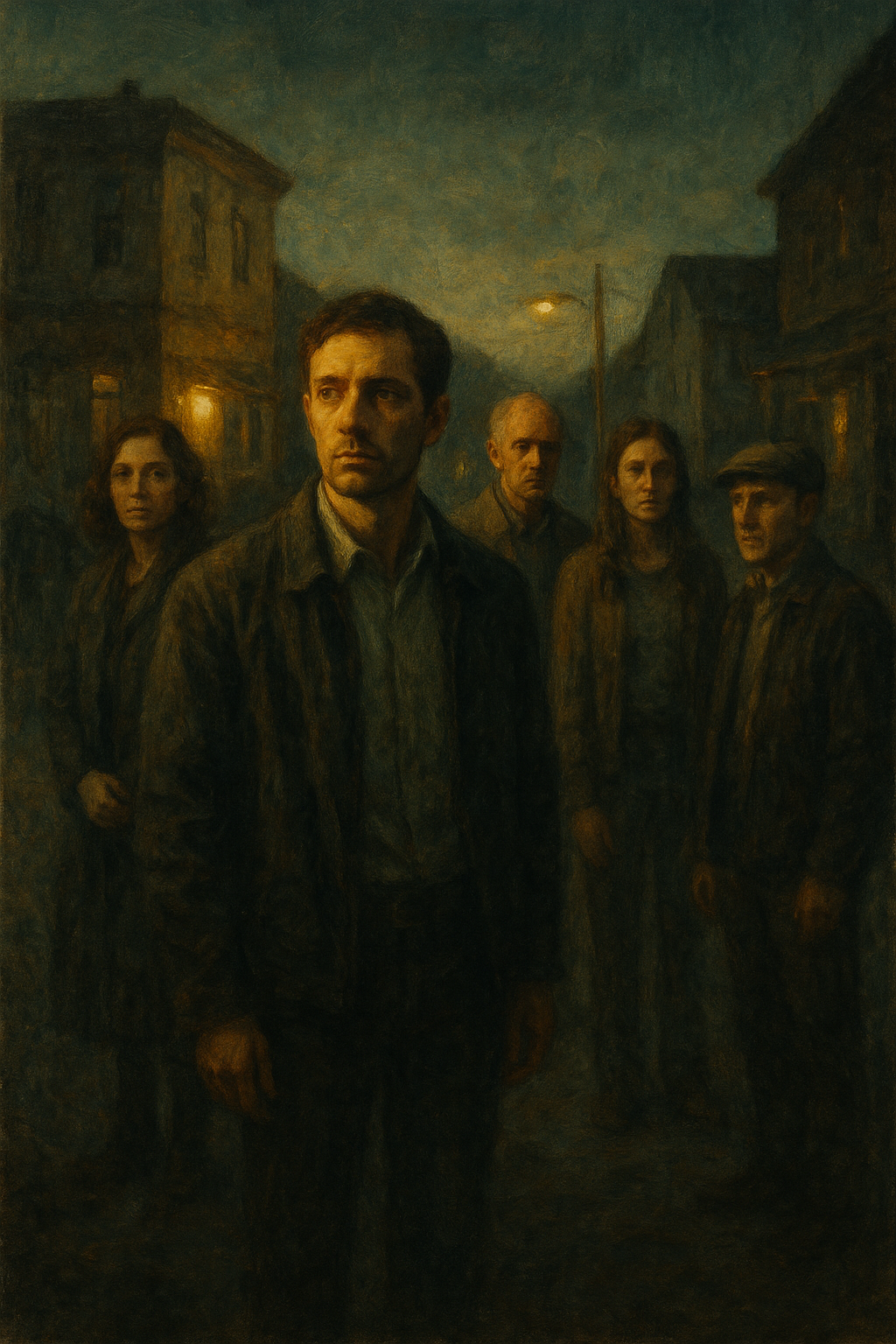
Echoes of Locus
The card sits face-down on the desk because that is how he leaves it every morning, a small private liturgy. Government-issue laminate, corners gone soft as cloth from eleven years of being turned and turned and never read out loud. There is a coffee ring on the desk that predates him. The card avoids it. The card always avoids it.
His name is Adrian Vey and his job, stated plainly, is to file other people's interiors. Locus Archive, Sub-Level Two, Cabinet Row F through M. When a citizen sits for assessment, the calibration produces a tail of raw data, the pre-score arithmetic, the worksheet before the worksheet. That tail comes to him. He logs it. He shelves it. He does not, as a rule, read it. Reading it is not forbidden so much as pointless. The numbers belong to people he will never meet, and the people belong to a system that has already decided what to do with them.
A word about the system, briefly, because you will need it. Every adult carries a locus score. The score, the public materials say, measures the center of gravity of your inner life. Whether your mind lives forward, in possibility, or backward, in injury. High scorers ride the soft trains. They drink at the bright cafes. Their apartments face the park. Low scorers, and Adrian is a low scorer, ride the other trains and drink at the other cafes and face the other things. No one calls it a caste. The word used is tier. The word used is always tier. Adrian's tier permits him to handle the archive but not to query it laterally. He can shelve a file. He cannot ask the file a question. This is relevant.
The fluorescent above his station has been ticking for three weeks. Maintenance has been notified. Maintenance has notified him back that it has been notified. In the meantime the light hums at a pitch that lives just under thought, the way a refrigerator does, the way a marriage does in its bad year. He has learned to work inside it. Most of the people down here have learned to work inside something. This morning he is early. Forty minutes early, which is a small fact and also the whole fact. His re-assessment is scheduled for end of shift. After re-assessment his clearance will refresh, up or down, and his terminal will recognize him as whatever the refresh decides he is. He has, by his own quiet count, those forty minutes plus the shift itself, minus the time Maren spends standing behind him pretending to read the wall.
Maren is his supervisor. Last week he ran a query that returned a result he had not been looking for, a discrepancy of two decimals in a calibration constant that should not vary at all, and Maren had appeared at his shoulder before he finished blinking. She had not said anything. She had only watched the screen until he closed the window, and then she had gone back to her desk and made a note. He does not know what was in the note. He knows there was a note. He sits. He sets down his thermos. He pulls the card toward him without looking at it, the way you handle a thing whose face you have memorized. Then, because he is forty minutes early and because something in last week's two decimals has been sitting at the back of his mouth like a coin, he turns the card over.
The number on his locus card is not the number on his locus card. The printed value, the one issued to him eleven years ago and reprinted at every adjustment since, has been struck through. A single horizontal line, neat, deliberate. Above it, in red ballpoint, someone has written a different number. Lower. Meaningfully lower. The kind of lower that does not get you onto Sub-Level Two. The kind of lower that does not get you a desk at all. The handwriting is not his. He knows his own handwriting the way he knows the coffee ring. This is not it. The figures slope the wrong way. The seven is crossed. He does not cross his sevens.
The fluorescent ticks. Somewhere down the row a cabinet rolls open and rolls closed and the person who opened it sighs the small sigh of someone who has found what they expected to find. Adrian does not move. His thumb is on the corner of the card. His thumb has been on the corner of the card for a length of time he could not measure if asked. He thinks, with a clarity that surprises him, that whoever did this either wanted him to see it or did not imagine he ever would. He cannot tell yet which possibility is worse. He turns the card back over. Face-down. Exactly as he found it, aligned to the same invisible grid, the worn corner pointing the same worn way. From across the room it has not changed. From across the room nothing has happened. His hand stays on it.
Down the corridor, a door release sounds. Footsteps. Maren's, probably. Maren walks the way she reads, evenly, without hurry, as if everything she is approaching will still be there when she arrives. His hand stays on the card.