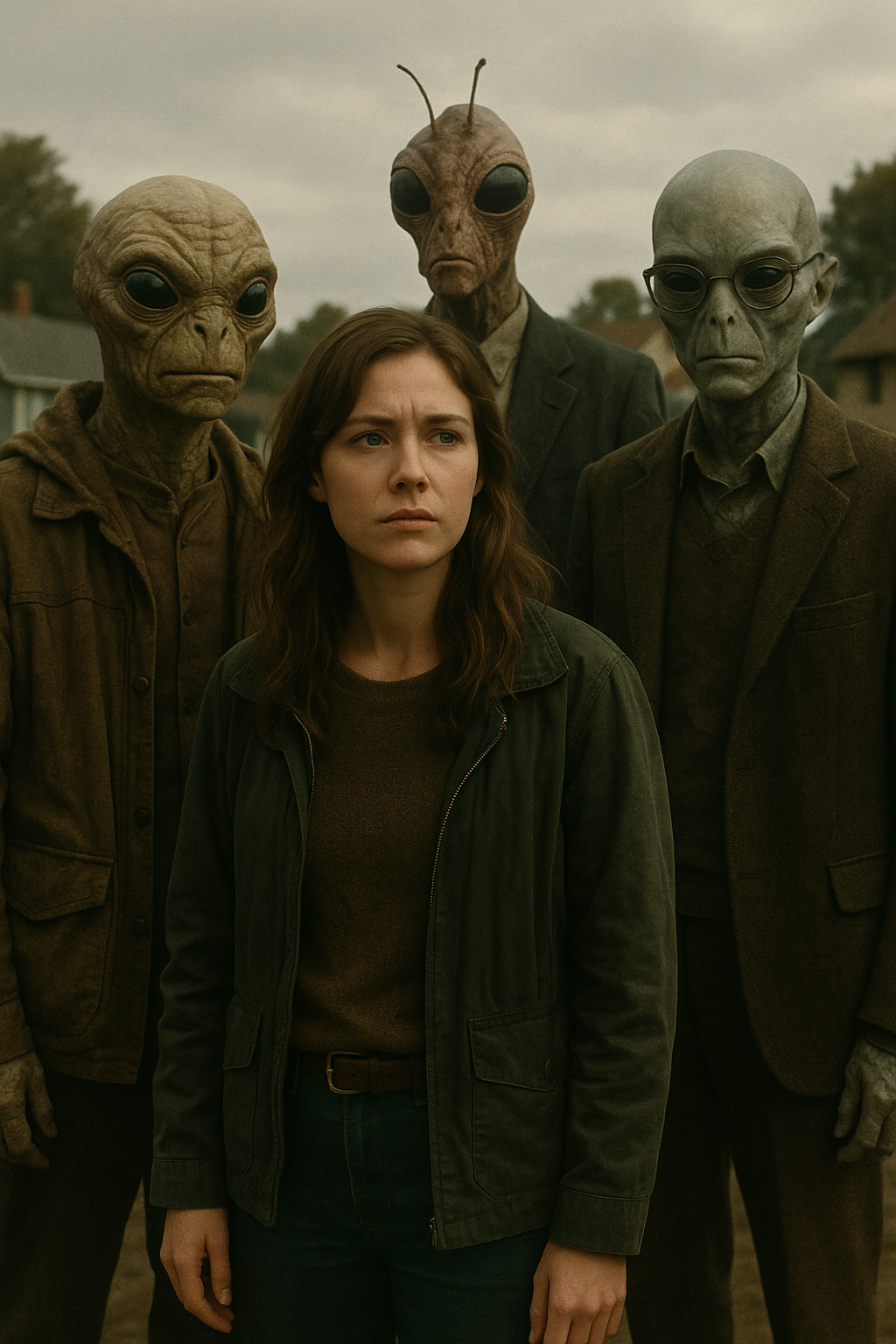
Strangers at the Science Fair
The banner over the entrance read GREY LOCH ANNUAL SCIENCE FAIR — WONDER AWAITS, hand-lettered in the kind of optimistic blue that doesn't survive a Saturday drizzle. One corner had already peeled free from its lamppost and was applauding itself, slowly, against the wet metal. Alex stood underneath it with both hands jammed in coat pockets and watched the corner flap for longer than was reasonable.
Alex had come because the alternative was reorganizing the spice cabinet. This is the kind of admission you make to yourself in a town like Grey Loch, where the fog rolls in off the water four days out of seven and the weekend options narrow to: drink, drive somewhere, or attend whatever the community center has put up flyers for. Alex was twenty-nine, had moved back two years ago for reasons that sounded better at the time, and had developed a low-grade allergy to the question what are you doing with your life. The science fair was, at minimum, a place where no one would ask.
Inside the hall, the air smelled like wet wool and warm electronics. A folding-table economy of trifold posters and dim LEDs, the usual middle-school volcanoes, a kid with a potato battery, a retiree who had built a small wind turbine out of bicycle parts and was very willing to explain it. Alex did one polite loop, nodded at the librarian, accepted a pamphlet about soil acidity, and was preparing to leave when the back third of the room registered as wrong.
It wasn't the inventions, exactly, although the inventions were the thing you noticed first. A man in a corduroy blazer was demonstrating what he called a passive thermal inverter, which appeared to be a copper bowl that made ice cubes from room-temperature water without being plugged into anything. He'd set up a hand-lettered sign reading PLEASE DO NOT TOUCH (HOT) next to a bowl that was visibly frosting over. Two booths down, a woman with a French braid was selling, or possibly just displaying, a small black cube that hummed at a pitch Alex felt in the molars. Her sign said MEMORY LATTICE — ASK ME ABOUT STORAGE. She was not asking anyone about storage. She was watching the man with the copper bowl with an expression you'd want a lawyer present for. And then there was Dr. Voss.
Her booth was the cleanest in the hall, which was its own tell. White cloth, white backdrop, a single device on a stand that looked like a music box crossed with a tuning fork, and a small placard reading QUANTUM RESONANCE — DEMONSTRATIONS HOURLY. Dr. Voss had silver eyes. Not grey, not pale blue. Silver, the way a coin is silver, and she met Alex's gaze across the room with the unhurried interest of someone identifying a bird. Alex went over. "What does it do," Alex said, which was meant to be casual and came out flat. "It resonates," said Dr. Voss, brightly. "Quantumly." "Right. With what." "Oh, with whatever's nearby that wants to." She smiled. Her teeth were very even. "Would you like to see it hum?"
It hummed. It hummed in a way that made the overhead fluorescents stutter, just for a second, just enough that Alex glanced up and Dr. Voss did not. When Alex looked back, the man from the copper bowl booth was suddenly at Alex's elbow, holding out a paper cup of cider with both hands, saying something warm and meaningless about the rain. By the time Alex had taken the cup and turned around, Dr. Voss was deep in conversation with the braid woman, and the music box was covered with a cloth.
This happened three more times in the next forty minutes. Alex would drift toward the white booth. Someone would intercept. A pamphlet, a question, an offered cookie, once an entire unsolicited explanation of magnetism from a man who introduced himself as Bram and did not blink for the duration. They were polite. They were relentless. They were, Alex began to suspect, coordinating. The badge was on the floor near the coffee urn. A standard plastic clip-on, EXHIBITOR printed across the top in the same optimistic blue as the banner outside. Alex bent to pick it up, meaning to hand it back to whichever absent-minded inventor had dropped it, and read the name. MARGARET ELLISON KEYS.
Alex knew that name. Alex's mother had clipped the obituary in 1987 and kept it in the drawer with the good silverware, for reasons Alex had asked about once and been told, gently, to leave alone. Margaret Ellison Keys had been a chemistry teacher at the high school. Margaret Ellison Keys had died in a car accident on the coast road the spring before Alex was born. Same spelling. The middle name was the part you didn't make up.
The lamination at the corner of the badge had lifted slightly, the way an old sticker peels when the glue gives out, and underneath the printed name was something else. A mark. Not a logo Alex recognized, not a letter from any alphabet Alex had sat through a class on. Three curved lines meeting at a point, with a small unfilled circle floating above where they joined. Alex held the badge closer to the light and the mark seemed, briefly, to be the wrong color for the paper it was printed on. Alex looked up.
Across the hall, Dr. Voss had turned toward Alex. So had the man with the copper bowl. So had the woman with the braid. None of them had spoken first. None of them were looking at each other. They were looking, all three, at Alex, with the same small attentive tilt of the head, as if listening for something Alex had not yet said. The banner outside slapped wetly against its lamppost. Inside, no one moved. Alex put the badge in a coat pocket.