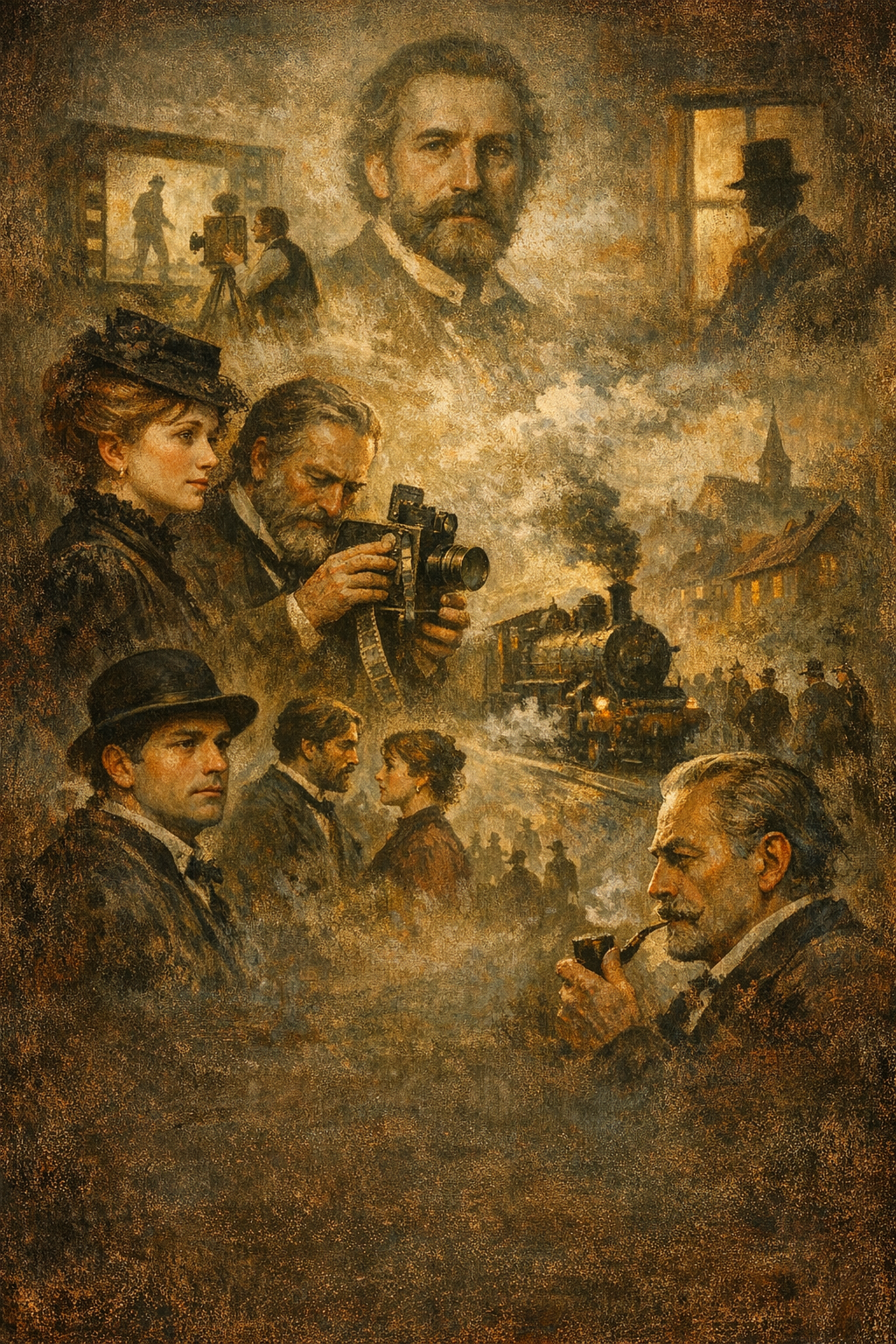
The Unraveling Dream
Three days before the train to Paris, Louis Le Prince stood in his Leeds workshop with a strip of celluloid held against the window, and the afternoon came through it in amber squares. Sixteen frames per second. A woman in a long dress walking across a lawn. A man in a bowler, lifting one knee, then the other, then gone. The garden at Roundhay, caught and held, released again into light. He did not smile. People who worked with him often remarked on this. His daughter would later say that her father, in the moments one might expect pleasure from him, instead went very still, as if listening for a sound beneath the obvious one. He was listening now. The strip trembled slightly between his fingers, which was not nerves exactly. He had not eaten since morning.
On the worktable behind him lay the usual geography. Brass fittings arranged by diameter. A single-lens camera he had built himself, its wooden housing darkened at the corners where his hands had worn it. A newspaper, folded twice, with a short column near the bottom concerning patents filed in New Jersey by a Mr. Thomas Edison. The paper had been folded in such a way that the column sat uppermost. Whether he had done this deliberately or whether the fold was accidental and he had simply not turned it over, no one could say. The paper stayed where it was for several hours.
Downstairs, Lizzie was arranging chrysanthemums in a jug that had belonged to her mother. She hummed while she worked. The tune was nothing in particular, a thing she did with her mouth when her hands were busy and her mind was elsewhere. She had been humming since breakfast. She was fifty-two years old, she had known this man for sixteen years, and she had learned to read the house the way a sailor reads weather. Something upstairs was wrong. She could not have told you what. She trimmed a stem at an angle and set it in the water and began again.
Adolphe came in from the garden with mud on his boots and the easy carelessness of a son who has not yet understood that his father is a man who can be lost. He asked after supper. She told him. He went up the stairs two at a time and knocked once on the workshop door and did not wait for an answer, because this had always been permitted, and Louis looked up from the strip of film and his face rearranged itself into something a child would recognize as welcome. "Show me," Adolphe said. Louis held the celluloid to the window again. The boy leaned in. For a long moment neither of them spoke, and the amber squares passed slowly across the glass. "That's Uncle," Adolphe said. "Walking." "That is the method," Louis said. "Your uncle is incidental."
Adolphe laughed, because he had been raised to find his father funny, and because the alternative was to find him strange. He asked when the train left. Louis told him. He asked whether his mother knew yet about Paris, and Louis said, after a pause the boy was too young to measure, that there was time enough for that. When the boy was gone, Louis sat down at the worktable and opened the letter again. It had come Tuesday. The postmark was smudged, perhaps deliberately, perhaps by rain. He had read it four times already and each reading had removed a little more of the color from the room. He read it a fifth time now. Then he folded it along its original creases, slid it into the breast pocket of the coat that hung on the door, and did not look at it again.
There is a thing people do when they have decided something they do not wish to examine. They become busy. Louis became busy. He wound eight reels of film and set them in their tins and set the tins into a leather satchel with a brass clasp. The satchel had been a gift from Lizzie, early in the marriage, for a journey he had taken alone to Paris and returned from happily. He fastened the clasp. He carried the satchel into the bedroom and knelt and slid it beneath the bed, far back, where the housekeeper did not sweep. Then he stood at the mirror and straightened his collar.
He did this slowly. He adjusted the cuffs of his shirt so that an equal measure of white showed at each wrist. He smoothed the front of his waistcoat. He looked at the man in the mirror the way one looks at a stranger whose cooperation is required. The man in the mirror looked back and agreed to be ordinary for the duration of the evening. At supper he was courteous. He asked after the chrysanthemums. He complimented the soup. Lizzie, passing him the bread, noticed the corner of an envelope rising from the breast pocket of the coat on its hook by the door, and she opened her mouth to ask about it, and then she did not. She told herself it was correspondence. She told herself he would speak when he was ready. She hummed a bar of the tune from the morning and reached for her glass.
After the children had gone up, she asked him what time the carriage was coming on Thursday. He told her. She asked whether he would be gone long. He said he did not think so. She waited for more, in the particular way she had, which was to leave a silence open like a door. He did not walk through it. He said something about the weather in Paris at this time of year, and she said, you know, it can turn so quickly, and he agreed that it could. Later, when the lamps downstairs had been put out and the house had gone into that soft creaking that old houses make when they are left to themselves, the bedroom was quiet. Louis slept, or appeared to. Lizzie lay on her side and watched the window.
Beneath the bed, in the thin gleam of a lamp someone had forgotten to extinguish fully in the hall, the brass clasp of the leather satchel caught a single line of light and held it. From the floor below, briefly, came the sound of Adolphe laughing at something his sister had said, and then the laughter stopped, the way a shutter stops, and the house was quiet again.