
Make your own audiobook+Make your own audiobook
Poster for E42

E42

The infamous mouse Experiment 42 in which a colony of mice implodes as a result of being provided for is tried out on humans as our main character wakes up from a decades-long coma, and wanders out of the hospital to realize slowly that his hometown has walls that have never been breached. He considers doing so with one semi-rationale cohort by his side. Everyone else is scheming and going quite insane.

Graphene
Written. Spoken. Yours.
Graphene
Written. Spoken. Yours.
←

E42

8 chapters · ~34 min read

novella

The infamous mouse Experiment 42 in which a colony of mice implodes as a result of being provided for is tried out on humans as our main character wakes up from a decades-long coma, and wanders out of the hospital to realize slowly that his hometown has walls that have never been breached. He considers doing so with one semi-rationale cohort by his side. Everyone else is scheming and going quite insane.

Chapter 1 · ~4 min read

Awakening in a Silent World

6:24

The fluorescent tube above the bed buzzed at a frequency that belonged to no decade in particular. It was the first thing Ethan heard, and for a long while it was the only thing. The paper gown clung to his back in the cooled, sour way of a sweat that had dried and re-dampened and dried again. Somewhere down the hall, a door eased shut. A pause. It eased shut again. Then, with a patience that felt almost considerate, a third time. His eyes opened onto a ceiling tile with a brown bloom in one corner, shaped like a country he could not name. He thought, briefly, that he had been looking at it for a while. He thought, also briefly, that he had no way to test that.

•••

His hand, when he lifted it, surprised him. It was his hand. It was also not. The skin had gone loose at the knuckles in a way that suggested either a long illness or someone else's wrist entirely. He turned it slowly in the buzzing light. There was a plastic band around it with a name he recognized, printed in a font he didn't. A woman came in. Older, soft around the eyes in the way of people whose softness has been practiced. She said his name in a voice already tuned to him, as though she had said it earlier that morning, and the morning before. She said, we're so glad you're back with us. She did not say from where. He asked how long. The question came out cracked, the consonants unsteady, and he was surprised at the sound of his own throat.

•••

A very long time, she said. She smiled. The smile arrived a half-beat after the sentence, the way a translation arrives a half-beat after the original. Dr. Reeves will explain. We'll get you something to eat. We'll take it slow. The we did a lot of work in those sentences. He noticed it the way a man notices a stone in his shoe before he has decided what to do about it. She brought broth. She brought a cup of water with a bend in the straw. She adjusted a blanket that did not need adjusting and left the door open four inches, no more, and he listened to her shoes go down the corridor at a pace that was not quite a walk and not quite a stroll, but something rehearsed between the two.

•••

When he sat up, the room tilted in a direction rooms are not supposed to tilt. He waited for it to stop. He put one foot, then the other, on a floor that was colder than he expected and farther away than it should have been. His legs were thinner than his memory of his legs. He could not produce a memory of his legs to compare them to, exactly, only the shape of an assumption, and the assumption did not match.

•••
“

She brought a cup of water with a bend in the straw.

He walked. It was generous to call it walking. He used the wall, and then the rail along the wall, which someone had thought to install, and then the doorframe, and then the wall again. The corridor stretched away under the same buzzing light, doors on either side mostly closed. He passed a station where a younger woman in scrubs sat with her back very straight, typing. He waited for her to look up. She did not look up. She typed with the focus of a person who had been told, specifically, not to look up.

•••

He kept going. At the end of the hall there was a sign with an arrow and a word he had once known well. Exit. The arrow pointed down a stairwell that smelled faintly of paint, and he took the stairs the way an old man takes stairs, which is to say he took them as a negotiation. The ground floor opened into a small vestibule. Glass doors. Beyond them, a parking lot in early light, and beyond that, the soft outline of a town that he understood, in some pre-verbal place, was his. He felt his chest do something it had not done upstairs. He put his hand on the push-bar. The bar did not move. He looked down.

•••

A zip-tie had been threaded through the bar and the frame and pulled tight. It was bright orange, the orange of road crews and hunting vests, and it was new. The plastic still had the high gloss of something unhandled. No dust in the ridges. No yellowing at the lock. Someone had put it there recently. Someone had put it there on purpose. He pushed again, more from disbelief than hope. The bar gave a quarter inch and stopped against the tie with a small, definite sound.

•••

At the far end of the corridor behind him, a nurse had paused with a clipboard against her hip. The older one. She was looking at him. She saw him see the tie. She saw him understand that she had seen. And then, without hurry, without a word, she turned and walked the other way, her shoes making that same rehearsed sound on the linoleum, neither alarmed nor unalarmed, as if his discovery had been one of several possible mornings and she had been briefed on all of them.

•••

He stood there a while. The vestibule was very quiet. The glass of the door had gone dark against the brighter outside, and in it he found a man he did not entirely recognize. Gaunt at the cheeks. Grey along the jaw in a stubble that was not a choice. A gown printed with tiny blue diamonds, the pattern of a thing meant to be glanced at and forgotten. One hand still resting, uselessly, on the bar. He looked at the reflection. The reflection, patient, looked back.
•••
Next · Ch 2 →
Walls of a Forgotten Life
Chapter 2 · ~4 min read

Walls of a Forgotten Life

6:44

Cracked asphalt baking in flat midday sun, and Clara's sneakers stopping just short of a chalk line drawn across the full width of the street. One sneaker white. One grey. Ethan noticed because his eyes were still tuning themselves to daylight, and small wrong things kept landing first. The chalk line was thick. Drawn slowly, by someone who cared about the edges. "We go around," Clara said. "Around what." "Around the line."

•••

She stepped off the curb, traced a small arc into the gutter, and came back up onto the sidewalk on the far side without breaking stride. Ethan followed because the alternative was standing in the sun in a hospital gown and a borrowed jacket that smelled like someone else's sweat. He had been awake, by his count, for about four hours. He had been walking for one. His legs had the soft uncertainty of furniture that had been in storage. He kept expecting them to fold. Clara did not look back to check. She moved through the town the way a nurse moves through a ward at night, knowing where every cart is parked.

•••

They passed a streetlight painted matte black from base to bulb. Then another. Then a bench bolted to face a brick wall, six inches from it, so that anyone sitting would have to stare into the mortar. A man was sitting on it. He did not turn. "Clara." "Mm." "Who built the walls." "Let me show you the square first." Which was not an answer. He noted it. He had been awake four hours and he was already keeping a list.

•••

The square, when they reached it, had been a square once. Ethan remembered a fountain there, a cement basin shaped like a clover, and on summer afternoons his mother used to let him put his feet in it while she read paperbacks with cracked spines. The fountain was gone. In its place someone had arranged newspaper, torn into rough squares, in a spiral on the flagstones. The squares spelled the same word, over and over, in fragments. He could read THER and OTHER and MOTH and could not tell if it was one word or three. A woman in a cardigan walked around the spiral counterclockwise, slowly, the way someone walks a labyrinth. She did not look at Clara. Clara did not look at her. It had the smoothness of a thing rehearsed. "How long has it been like this," Ethan said. "Define like this." "Clara."

•••

She stopped. She turned to him for the first time since they'd left the hospital parking lot, and he saw, in full sun, how tired she was. Not the tiredness of a bad night. The other kind. The kind that settles into the bones and becomes posture. "What they're calling it," she said, "is Experiment Forty-Two." She said it the way a person reads a street name off a sign. No drop in pitch. No glance away. "What does that mean." "It means what's happening here has a number." She watched his face. "Ethan. How much do you remember about the day of the accident."

•••

There it was. The thing he had been groping at since he opened his eyes and couldn't find. He remembered the inside of her father's station wagon. He remembered her hand on the gearshift, the chipped nail polish, a song on the radio he couldn't name now and probably couldn't have named then. He remembered laughing about something. After that there was a clean white edge, and then a hospital ceiling forty-three years later. "The car," he said. "Up to the car." She nodded once, like a box being ticked. He wanted to ask her how she knew to ask it that way. He wanted to ask her where she had been for forty-three years, why she was here, why she was the one who came when the hospital called, who had called, who was calling anyone about anything anymore. He wanted to ask about the walls. "Clara, who built"

•••
“

He had been awake, by his count, for about four hours.

"Come see," she said, and started walking again. Her street was four blocks east, a row of houses he half-recognized under a layer of something that was not quite neglect. The lawns were cut. The cars in the driveways were old but clean. It was the small things. A mailbox painted shut. A welcome mat laid upside down. Curtains drawn at noon in every window on the block, except one, where a curtain had been removed entirely and replaced with what looked like aluminum foil, taped at the corners. At the end of the street the houses stopped, and the thing he had been refusing to look at directly since they left the hospital became the only thing to look at.

•••

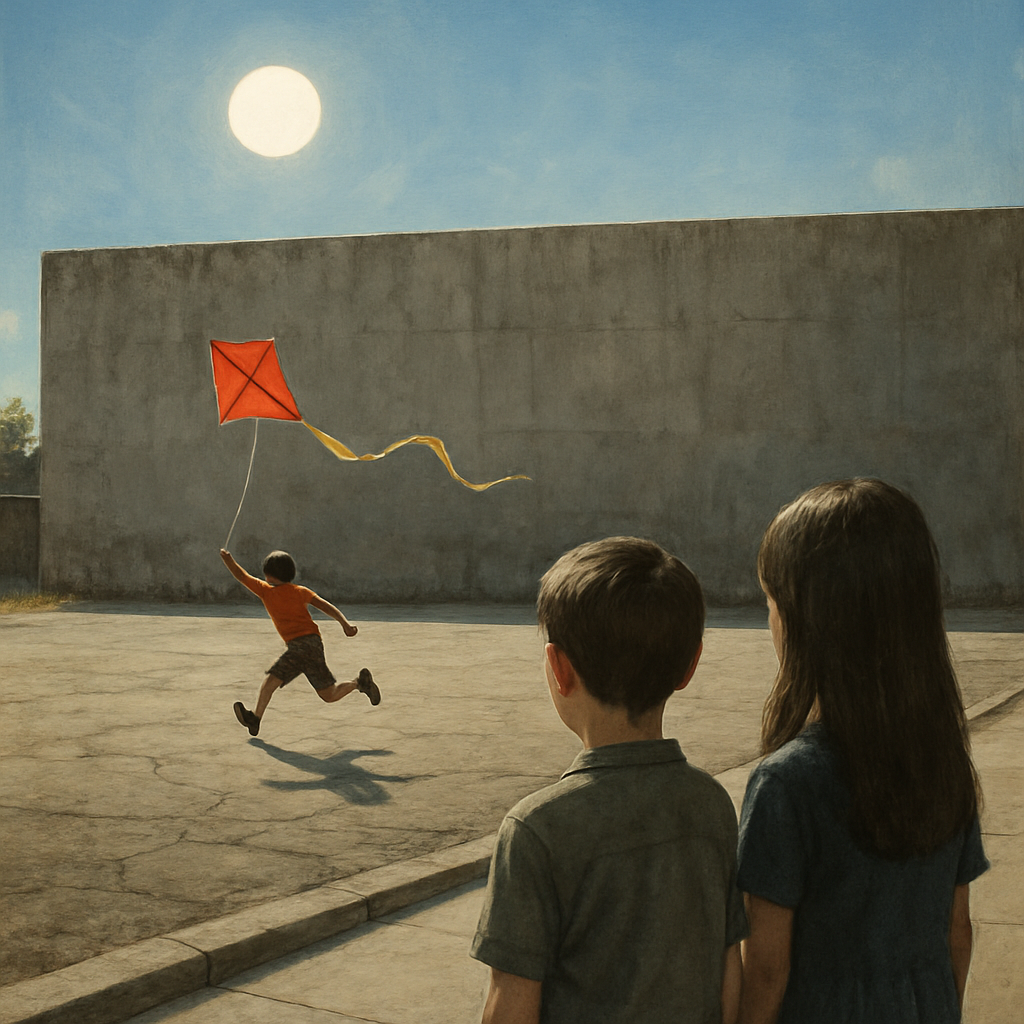
It was concrete the color of old teeth. It went up four stories, maybe five, it was hard to tell because there was nothing beside it to measure against. It ran left until it disappeared behind the roofs, and it ran right until it disappeared behind the roofs, and there was no seam in it, no gate, no door, no ladder, no scaffold, no graffiti, no window, nothing. Just a long pale curve eating the horizon. In the empty lot at the foot of it, a child was flying a kite.

•••

The kite was red. It had a tail of yellow ribbon. The child was running back and forth with the focused seriousness of children at play, and the kite was up, technically, it had caught some pocket of air, but it was not above the wall. It was not even close to above the wall. It hung at about the height of the rooftops, twitching slightly, going nowhere. Ethan stood on the cracked sidewalk and watched the kite not rise. Clara stood beside him and did not say anything, which, he was beginning to understand, was the way she said the most.

•••
← Previous · Ch 1
Awakening in a Silent World
Next · Ch 3 →
Echoes of the Mind
Chapter 3 · ~5 min read

Echoes of the Mind

7:49

The basement smelled of wet cardboard and kerosene, and underneath that, the sweet rot of something organic that nobody had identified or wanted to. Four candles burned on an upturned milk crate, mismatched in height and color, the way candles are when people have been gathering them one at a time from drawers in other people's houses. A man in the corner was tearing pages from a paperback novel. He worked slowly. He creased each page along the spine, drew it free with both hands, and laid it on a stack on the floor beside him. The stack was a perfect grid, four pages wide, and he was building it like masonry. Nobody had introduced him to Ethan. Nobody had introduced anyone.

•••

Clara had brought them here through three back alleys and a courtyard where someone had arranged shoes in a circle, toes pointing inward. She moved through the route the way she moved through everything, which is to say she did not appear to be choosing it. She stopped at a door, knocked twice and then once, and a woman with a long gray braid had opened it without speaking and looked at Ethan for a longer time than was comfortable before standing aside.

•••

There were six of them in the basement now, counting Ethan and Clara. The woman with the braid was Margery. The man tearing pages was Doss. There was a younger woman named Pell, who had the look of someone who had recently been crying and was now refusing to, and a thin man called Harlan who would not sit down. He stood with his back to the wall, near the stairs, his hands working at his sleeves. "He's the one from the hospital," Margery said. It was not a question. She was speaking to the room, not to Ethan. "He's been asleep," Clara said. "For how long." "Long enough." Margery nodded once, as if this were a satisfactory answer, which Ethan found alarming.

•••

The conversation that followed had the shape of a conversation these people had already had several times. Harlan wanted to go over the wall. He had been saying so, he told Ethan, for eleven months. He had it worked out. There was a stretch on the north side, behind what used to be the lumberyard, where the wall met an old retaining slope, and if a person could get up the slope, the climb itself was only about twenty feet of vertical. He'd measured it. He'd measured it with his eyes, he clarified, because measuring it with a tape had felt conspicuous. Pell said the wall was thirty feet on the north side. She'd measured it too. "Thirty on the east," Harlan said. "North is shorter." "North is the same as east. They built it at the same time." "They built it in sections."

•••
“

The conversation that followed had the shape of a conversation these people had already had several times.

"They built it in one pour. My father was a contractor." "Your father was a dentist, Pell." Pell went quiet for a moment, looking at the candles, and then said, with a kind of administrative calm, "My father was a contractor on Tuesdays." Ethan watched her face when she said it. She did not appear to be joking. She also did not appear to notice that she had said anything strange. Clara, beside him, did not react at all, and that was its own kind of reaction. Margery wanted to dig. She had read, somewhere, that the wall's foundation was only four feet deep, and that a person with a shovel and a week could be under it. When asked where she'd read this, she said she couldn't remember, but it was a reliable source. When asked what reliable meant, here, now, she changed the subject to drainage.

•••

Doss, in the corner, said nothing. He tore pages. Ethan tried, twice, to bring the conversation to a question of what they would do once they were over, or under, or through. Both times the question was absorbed and disappeared. Harlan wanted to talk about the slope. Margery wanted to talk about shovels. Pell wanted to talk about whether the wall was thirty feet or whether it had always been thirty feet, which she seemed to feel was a separate question. The arguments tightened. Voices went up, then down, then up again in a rhythm that suggested practice.

•••

At some point Harlan accused Margery of being a plant. Margery accused Harlan of having been seen, twice last week, walking on the wrong side of the chalk line on Eddow Street. Harlan said the chalk line had moved. Margery said the chalk line did not move. Pell said the chalk line moved on Tuesdays, and then put her hand over her mouth as if she had surprised herself. Doss stood up.

•••

He did it without hurry. He crossed the three steps to the crate, took the topmost page from his stack, and held it to the nearest candle. The corner caught. He did not flinch. He held the page level, the way you'd hold a letter you were reading, and let the flame travel up it. The room stopped. Even Harlan stopped, his mouth open on whatever he'd been about to say. The page curled, blackened, broke into pieces of ash that drifted onto the concrete floor. Doss watched it the entire way down. When the last of it was gone he sat back in his corner and picked up the paperback and tore the next page along its spine.

•••

Nobody asked him what it meant. Ethan understood, watching the others not ask, that nobody asked him anything anymore. That this was something he did, and that it was tolerated, the way you tolerate weather. Clara, beside Ethan, finally moved. She leaned to his ear and said, very quietly, "He used to be a teacher." She did not say of what.

•••

The argument resumed eventually, but with less of itself in it. Harlan agreed to walk the north slope with Pell tomorrow, at dusk, and to bring back a real measurement. Margery agreed to find a shovel. Nobody agreed on what they were agreeing to, exactly, but a thing had been decided, and the decision was that there would be another meeting, and that at the next meeting they would know more than they knew now. Ethan suspected this was not true. He also suspected that suspecting it was the most useful thing he had done all evening.

•••

They filed out one at a time, at intervals Clara enforced with small touches to elbows. Doss did not leave. When Ethan looked back from the stairs, Doss was still in his corner, working. The stack on the floor was taller now, neat as ever, four pages wide. In the middle of it, three rows down, was a single black gap where the burned page had been, and the candle above it was still threading smoke up toward the low ceiling, slow, unbroken, going nowhere it could be followed.

•••
← Previous · Ch 2
Walls of a Forgotten Life
Next · Ch 4 →
Crossing the Point of No Return
Chapter 4 · ~5 min read

Crossing the Point of No Return

6:39

The cord they used was orange. Ethan keeps coming back to that, later. Not the height, not the cold pressing in through his jacket, not even the sound of Mara breathing through her teeth two rungs below him. Orange electrical cord, the kind you'd run to a lawnmower, lashed in figure eights around iron rungs they'd pulled out of a basement somewhere on Ottilie Street and stacked into something resembling a ladder. The whole assembly shuddered every time someone shifted their weight. It was, he thought, the stupidest object he had ever trusted his life to.

•••

Pre-dawn had drained the color out of everything. The wall in front of his face was not gray so much as the absence of any other option. His palms were raw where the iron had worn through his gloves and then through the first layer of skin underneath, and he could feel each rung now as a separate small pain, accounted for, filed away. Clara had told them where to put the ladder. Not in words exactly. She had walked the perimeter with Ethan two nights before and stopped, without announcement, at a section of wall that looked identical to every other section, and said, this one. When he asked why, she said, the seam is closer to the surface here. When he asked how she knew, she did the thing where she didn't answer and he eventually stopped waiting.

•••
“

It was, he thought, the stupidest object he had ever trusted his life to.

Four of them on the ladder. Ethan at the top. Mara below him, then Pell, then Jonas at the bottom holding the base steady with his shoulder pressed into the wall like he was trying to keep a door closed against weather. Clara was somewhere on the ground. She had said she would watch. Watch what, he hadn't asked. He was perhaps a foot from the top when the light came. It came from below and to the left, a clean white cone, the kind of beam that belongs to a flashlight someone has maintained. It swept across the wall once, found him, slid past, and then came back and held. He could feel the warmth of it on the side of his face. He did not turn his head. A voice said, evenly, We've been waiting for someone to try this.

•••

The voice was not Clara's. The voice was male, calm, and a little tired in a way that suggested a long shift rather than a hard life. It was the tone of someone who had been told what to say and had said it more than once. Below him, Jonas made a small sound. Pell said a word Ethan didn't catch. Mara, to her credit, kept climbing for another half rung before she understood, and then she stopped, and the ladder stopped shuddering, and they all hung there together in the cone of white light like specimens. Ethan looked down.

•••

There were maybe six of them. He couldn't get an accurate count because of the light, but he could see shapes, and the shapes were spread out in a way that suggested practice. They weren't crowded together the way townspeople crowded. They stood the way people stand when they have done a thing before and know where the other people are without looking. Two of them were holding something long. He chose, in the moment, not to identify what. One of them was closer to the ladder than the others. He was the one with the flashlight. He was looking up at Ethan with the patient expression of a man waiting for a kettle. Where's Clara, Ethan said. He hadn't meant to say it out loud.

•••

The man with the flashlight tilted his head, just slightly, as if the question were interesting in a small way. He didn't answer. He moved the beam down, off Ethan's face, and onto the base of the ladder, where Jonas's shoulder was still pressed against the wall. The second man stepped forward into the cone of light with something in his hand that caught and threw the beam back in a brief metallic flash. He bent at the waist. He did not hurry. Ethan watched, from twenty feet up, as the man took the orange cord at the base of the ladder in his gloved hand and cut it in a single motion that suggested the cord had been waiting all its life to be cut.

•••

Jonas went down first because he was already leaning. Pell tried to grab the wall and there was nothing on the wall to grab. Mara made a noise that wasn't a word. Ethan, at the top, felt the rung under his hand go from solid to suggestion, and he did the only thing his body knew to do, which was let go of the ladder and grab the lip of the wall above him with both hands. His fingers found stone. His feet found nothing.

•••

The ladder peeled away from the wall beneath him with a long slow grace, the cord whipping loose in the wind, and he heard the others hit the ground in a sequence that was almost musical, one two three, soft and not soft and soft again, and then voices, low and unhurried, the kind of voices people use when they are gathering up something they planned to gather. He hung there. His arms shook. He could not see over the top of the wall from this angle. He could only see the gray sky above him and feel the stone biting into the meat of his fingers and hear, somewhere below, a man saying, get him down, careful, we want him. He did not look for Clara. He understood, in the part of himself that he had been trying not to consult, that he would not find her by looking.

•••

The ladder, what was left of it, swung loose at the bottom, still lashed to the wall halfway up by a knot someone had tied well. One rung turned slowly in the wind. Then another. The orange cord, freed at one end, lifted and fell and lifted again, like something waving.

•••
← Previous · Ch 3
Echoes of the Mind
Next · Ch 5 →
Fractured Alliances
Chapter 5 · ~4 min read

Fractured Alliances

6:02

Morning came through the boards in stripes. The kitchen had been someone's once, in the way all the rooms in the house had been someone's, and the light fell across the table in even rungs, and across Clara's hands, which were folded, and across a folded paper between her hands, and she did not look up when Ethan came in.

•••

He stopped in the doorway. He had been planning, upstairs, what he would say. He had a route now. He had a section of the wall he wanted to walk her to, and a question about what she had meant by the wall isn't the only thing they built, and he had decided, somewhere between the third and fourth hour of not sleeping, that he would ask the question before he showed her the route. That order felt important. He had been a man, before the coma, who believed in orders of operation. The coma had not taken that. Clara said, without looking up, There's coffee. There wasn't. The pot was dry. He understood she was saying it the way a person says sit down. He sat down.

•••

In the next room, two of the others were arguing in the controlled whisper people use when they want to be overheard and want deniability for having been overheard. He caught the word her and the word knew and the word obviously. Then a chair scraped, and someone walked out the back, and the door did not close all the way behind them. Clara waited until the steps were gone. Then she slid the paper across the table. It was folded into quarters and the creases had been opened and closed so many times the paper had gone soft at the seams and split in two places. He took it with the kind of care you give a thing that might come apart in your hands. He unfolded it.

•••
“

He understood she was saying it the way a person says sit down.

His name was typed at the top. Beneath his name were paragraphs he did not read, because his eye had already gone to the bottom of the page, to the line, to the signature on the line, which was his, and to the date next to the signature, which was three weeks before a morning he did not remember and a coma he had woken from in a city he no longer understood. He looked at her. She looked at him. He said, How long have you had this. She said, Long enough. He said, You knew.

•••

She said, I knew what you signed. I knew you wouldn't remember signing it. I knew you'd wake up and need someone who could walk you through the streets without flinching, and I knew that if I told you what you'd agreed to, on the first day or the second day or the fifth, you would not have come with me to the wall, and you would not have seen what you needed to see, and you would not be sitting at this table now asking me this question. It was the longest sentence he had ever heard her speak. It had the shape of a sentence she had practiced. He said, Are you one of them. She said, I can't answer that. He said, Can't or won't. She held his eyes. She did not blink. She said, I can't.

•••

He waited for more. None came. She had said the thing she had come downstairs to say, and she was now waiting to see what he would do with it, the way a person at a desk waits to see what a subject will do with a stimulus. He understood, looking at her, that her tiredness was not the tiredness of someone who had been through something. It was the tiredness of someone who was running something, and had been running it for a long time, and had not slept because the thing she was running had reached a stage that required her to be downstairs, at this table, in these stripes of light, at this hour. In the other room, someone had come back in and was speaking, low, to someone else. He heard his own name. He heard the word decide.

•••

He folded the paper. He unfolded it. He folded it again. He understood, distantly, that his hands were doing this on their own, that this was what hands did when they needed somewhere to be while a person decided what to be. He stood up. He said, I need air. She said, Ethan. He said, I need air. She didn't stop him. She didn't stand. The stripes of light moved with the angle of the sun, and one of them slid up her wrist as he stepped past her, and he thought, with a clarity that surprised him, that she had chosen this chair for the light. That she had wanted him to see her hands.

•••

He walked through the front room. The two who had been whispering went quiet as he passed. He felt their eyes track him the way eyes track a thing that has not yet decided what it is. He did not look at them. He had not looked at any of them, he realized, in two days. He had eaten standing at the window. He had taken his bread to the stairs. He opened the front door. He stepped through. Behind him, on the kitchen floor where it had slipped from his hand without his noticing, the consent form lay face-down on the boards. One corner lifted in the draft from the open door, and settled, and lifted again, and settled, in a rhythm the room would keep without him.

•••
← Previous · Ch 4
Crossing the Point of No Return
Next · Ch 6 →
The Final Push
Chapter 6 · ~4 min read

The Final Push

6:22

At noon the wall throws almost no shadow. Ethan stands at its base with a length of galvanized pipe in his right hand and the orange zip-tie from the hospital door curled in his jacket pocket like a small, bright animal. He has been awake nine days. He has eaten three meals in the last two of them, each one standing up, each one alone. The pipe is heavier than it looks. He found it behind the pharmacy, leaning against a stack of bricks someone had arranged in a careful spiral. He didn't ask who. He's stopped asking who about most things.

•••

The street behind him is empty in the particular way the town does empty now, which is to say: not abandoned, but withheld. Curtains drawn at the angle of someone watching from behind them. Benches turned to face the houses. A child's kite tangled in a power line two blocks down, motionless, the tail hanging straight as a plumb. He had a plan, this morning. The plan involved four people. By ten, it involved two. By eleven thirty, it involved him.

•••

Marcus had gone first, which Ethan understood. Marcus had a daughter. Whatever the resistance offered him, it offered through her. Ethan watched him cross the chalk line at the end of Bellamy Street and not look back, and felt something that was not quite anger. More like recognition. The same recognition he'd been feeling for days, watching himself eat alone at a counter, watching himself stop asking Clara questions because the answers had begun to cost more than the not knowing. The other two he doesn't want to think about. One of them had been crying. The other had not.

•••

Clara is not here. Clara had told him, last night, in her flat practiced voice, that she would not be here. She had said it the way she said most things, as a fact she had already finished feeling. I won't be at the wall tomorrow. And then, after a pause that he now understands was the closest she comes to apology: You should still go. He had wanted to ask her which side she would be on. He had not asked. He understood, finally, that the question assumed sides, and the experiment had never assumed sides. The experiment assumed only participants and the rate at which they consumed each other. He lifts the pipe. He swings.

•••

The concrete does not crack. He had not, if he is honest, expected it to. What he had expected was the dull thud of a body hitting a body, the small dead sound of futility, which would have given him permission to set the pipe down and walk back to whatever was left of his life. Instead the wall rings.

•••

It is a long tone, low, almost musical, and it does not stop where the impact stops. It travels. He feels it move down the length of the wall in both directions, a vibration in the soles of his shoes, in the fillings of his teeth, in the soft place behind his sternum where, forty-three years ago, he signed something he does not remember signing. The tone carries down the street, around the corner of the pharmacy, into the squares and the alleys and the painted-over streetlights and the rooms behind the drawn curtains. The wall is hollow. He stands very still and listens to the sound of it deciding to be heard.

•••

Doors open. Not all at once. One, then another, then six, then more than he can count without turning his head, and he does not turn his head. He hears them. He hears feet on porches and feet on pavement and the small particular silence of a town that has, for the first time in seven years, agreed to listen to the same thing at the same time. The kite two blocks down does not move. The child holding its string, he assumes, does. No one speaks. No one calls out to him. No one tells him to stop and no one tells him to swing again. They simply stand in their doorways and on their steps and at the mouths of their streets, and they listen to the wall finish ringing. It takes a long time to finish.

•••
“

The experiment assumed only participants and the rate at which they consumed each other.

When he can no longer hear it with his ears, he can still feel it in his hand, traveling back up the pipe, traveling up his arm, settling somewhere under his collarbone. He sets the pipe down on the curb. He does it gently. He does it the way you set down something that has done what you asked of it. He puts his palm flat against the wall. The concrete is cool. Not cold. The vibration is almost gone now. He closes his eyes and waits for the last of it, and behind him the town does not move and does not speak, and somewhere in it, he knows, Clara is standing very still with her hand pressed to a different surface, listening to the same fading note, finishing some calculation she began before he was awake to be counted. He keeps his hand on the wall.

•••

He does not yet know whether he will swing again. He does not yet know whether the sound was the wall failing, or the wall answering, or the wall, simply, being heard for the first time by someone who had been built to hear it. Behind him, the town keeps not speaking. He keeps his eyes closed. The vibration fades into his palm and does not, entirely, leave.

•••
← Previous · Ch 5
Fractured Alliances
Next · Ch 7 →
The Architecture of Consent
Chapter 7 · ~4 min read

The Architecture of Consent

6:26

There is a particular kind of quiet that arrives when a man stops asking questions. Ethan had been inside that quiet for six days. He moved through the house Clara had given him, or assigned him, or stored him in, with the economy of someone who no longer expected to be observed. Which was, of course, the wrong assumption. He found the camera by accident. He was looking for batteries. The drawer in the kitchen had the kind of accumulation drawers acquire when someone is pretending to live somewhere, and at the back of it, behind a coil of twine and a stack of expired coupons for a grocery that no longer existed, was a small black disc with a pinhole at its center. It was warm. That was the detail he kept returning to later. It was warm, which meant it had been on.

•••

He sat with it in his palm for a long time. Then he stood up and started looking in earnest. There was one in the lamp. One in the smoke detector, which made a kind of sense. One in the spine of a book on the shelf he had never opened, a hardcover of poems by a man he had not heard of, the pages uncut. One above the door, recessed into the molding so cleanly that he only found it because he was now the kind of person who would find it. The consent form was still on the kitchen floor where he had left it. He had not been able to bring himself to throw it away or to pick it up. The corner lifted in the draft. He watched it settle. He watched it lift again. He walked to Clara's.

•••

She opened the door before he knocked. This had stopped surprising him. She looked at his face and stepped aside, and he came in and put the black disc on her table between them, and he said, How long. Clara sat down. She did not pick up the disc. She looked at it the way a person looks at a glass of water they have already decided not to drink. From the beginning, she said. He had prepared, on the walk over, for evasions. He had prepared for I can't and for the flat practiced corrections. He had not prepared for this, which was worse, because it required nothing further from her. She had said it and now she was waiting for him to do the rest of the work. The breach attempt, he said. The one that failed. Yes. Who watched it.

•••

She considered the question. Not the answer, he could see that. The question. As though deciding which version of it she was going to address. That isn't the part that matters, she said. It matters to me. I know it does. That isn't the same thing. He sat down across from her because his legs had made the decision before he did. Outside, somewhere down the street, a child was running a kite up into air that would not hold it. He could hear the small slap of the cloth against nothing. Clara, he said. What is the experiment measuring. And here, for the first time since he had known her in this second life of his, she closed her eyes. Not long. A second, maybe two. The composure did not break. It only paused, the way a clock pauses when you wind it.

•••

The walls don't do the work, she said. The walls have never done the work. People think the walls are the experiment. The walls are the set. Then what. Whether you stay, she said, when you believe you are choosing. Whether you leave, when you believe you are choosing. The choice is the instrument. The choice is what they record. He sat with that. He tried to find the part of it that was new and found, instead, that none of it was. It had been in the room with him for weeks. It had been in the consent form, folded and unfolded until the creases tore. It had been in her foreknowledge. It had been in the way the chalk line across the street had no one enforcing it and still no one crossed. So the breach, he said. Was data. And if we try again.

•••

Will also be data. He looked at her then, really looked, the way he had not let himself since the consent form. The exhaustion in her face was not the exhaustion of a person managing a difficult week. It was older than that. It was layered. It was the exhaustion of someone who had sat at this table before, across from a man asking these questions, and had answered them, and had watched what came next, and had done it again. How many times, he said. She did not answer. How many times, Clara. She reached across the table, finally, and turned the small black disc over so its pinhole faced the wood. A small gesture. Almost courteous. Go home, she said. Decide what you want to do. Whatever you decide is the thing they are waiting to see.

•••
“

He had not been able to bring himself to throw it away or to pick it up.

He stood up. He left the disc on her table. He walked back through the street where the kite hung in dead air and the benches faced inward and a man he did not know was rearranging torn newsprint on the curb into a word Ethan did not let himself read. At his own door he stopped. The draft was moving through the house. He could feel it from the step. Somewhere inside, the corner of the consent form was lifting and settling, lifting and settling, and he understood, standing there with his hand not yet on the knob, that going in was a choice and not going in was a choice and there was no third door. He went in anyway. That, too, had been accounted for.

•••
← Previous · Ch 6
The Final Push
Next · Ch 8 →
The Weight of Repetition
Chapter 8 · ~4 min read

The Weight of Repetition

6:17

The room Clara left him in had been a records office, once. You can tell by the bones of it. The shelving units bolted into the walls in a grid, the cheap industrial carpet worn pale in two parallel tracks where a chair used to roll. Someone had cleared most of it out and left the rest in filing boxes on the floor, lids off, like an invitation or a confession. The desk lamp was the only light. Its bulb was going. Every few minutes it dimmed a half-shade and then steadied, and Ethan would feel his pupils adjust, and then it would steady again, and the room would re-emerge, slightly different than he remembered it.

•••

He sat on the floor because the chair was gone. He had been sitting there for what he estimated to be about two hours, though his estimate was the estimate of a man whose watch was broken and whose body had recently spent an unknown number of years not counting anything at all. The first box held photographs. He went through them the way you go through a stranger's mail, half expecting to be caught. Faces. A man in his thirties with sandy hair, photographed in what looked like this hospital's lobby. A woman, older, mid-sixties, photographed against a wall Ethan recognized as the one outside his room. Each photograph clipped to a tab. Each tab a name. Each name a number underneath it, in pencil, in a careful hand. Subject 17. Subject 23. Subject 39.

•••

He was not looking for himself. He would say later, if there was a later, that he was not looking for himself. He was looking for the proof of a life. Something with his mother's handwriting on it. A school photograph. A receipt from somewhere he remembered going. The kind of paper trail a person accrues without trying, the kind that, laid out on a desk, becomes the shape of a self. What he found in the second box were files. Typed pages, the typing irregular, some of it from a machine and some from a printer of a generation he could not date. Compliance Trajectory, the header on each one read. And then a name. And then a chart. The charts all ended the same way. A line that rose, plateaued, dipped, rose again, and then dropped off the bottom of the page.

•••

He read three of them before he understood that the drop-off was not a metaphor. The third box was older. The cardboard was soft at the corners, the way cardboard gets when it has been sitting in a basement through a humid decade. He almost did not open it. He told himself, later, that he almost did not open it, although the truth was that he opened it the moment he saw it, the way a person opens a letter addressed to them in a hand they don't recognize. The tab read MERIDIAN, ETHAN. The date on the file was eleven years before the year he had gone into the coma.

•••

He sat with it closed on his lap for a long time. Long enough that the lamp dimmed and brightened twice. He was running, in his head, the list of explanations. Forgery. Misfiling. A different Ethan Meridian, a coincidence of names, a clerical accident dressed up as a revelation to break him. He arranged these explanations in order of decreasing comfort and then he opened the file. The photograph was paperclipped to the inside of the folder. A man in his thirties, sandy hair, sitting in a chair Ethan recognized as the chair from his own hospital room. The man was looking at the camera with the expression of someone who had just been told something he was still deciding whether to believe. The man had his face. Underneath the photograph, in the same careful pencil: Subject 42. Iteration 3. Compliance Trajectory: Terminal.

•••
“

He was looking for the proof of a life.

He did not move for some time. He was waiting, he thought, for the part of him that handled this kind of information to come online. It did not come online. What came online instead was a very small, very specific memory of being six years old and standing in his grandmother's kitchen, and the memory had the texture of something rehearsed, and he could not tell, sitting on the floor of that room, whether he was remembering the kitchen or remembering the last time he had remembered the kitchen, and the difference, he understood, was the thing the file was asking him to measure. Somewhere in the building, a door opened and did not close. He did not look up.

•••

He was thinking about Clara. About the flatness in her voice when she had handed him the key to this room. About how she had not said good luck and had not said I'm sorry and had not said anything at all, only watched him walk down the corridor with an expression he had read, at the time, as exhaustion, and was now reading, sitting here, as something closer to recognition. The lamp dimmed. Brightened. Dimmed again. He was sitting on the floor with the photograph face-up in his lap. The other files were spread around him in a rough half-circle, the way a person arranges things when they have not yet decided whether to put them back. From the doorway, though he did not turn to confirm it, he could feel that someone was standing in the dark, waiting to see what he would do.

•••
← Previous · Ch 7
The Architecture of Consent
Back to show →
E42