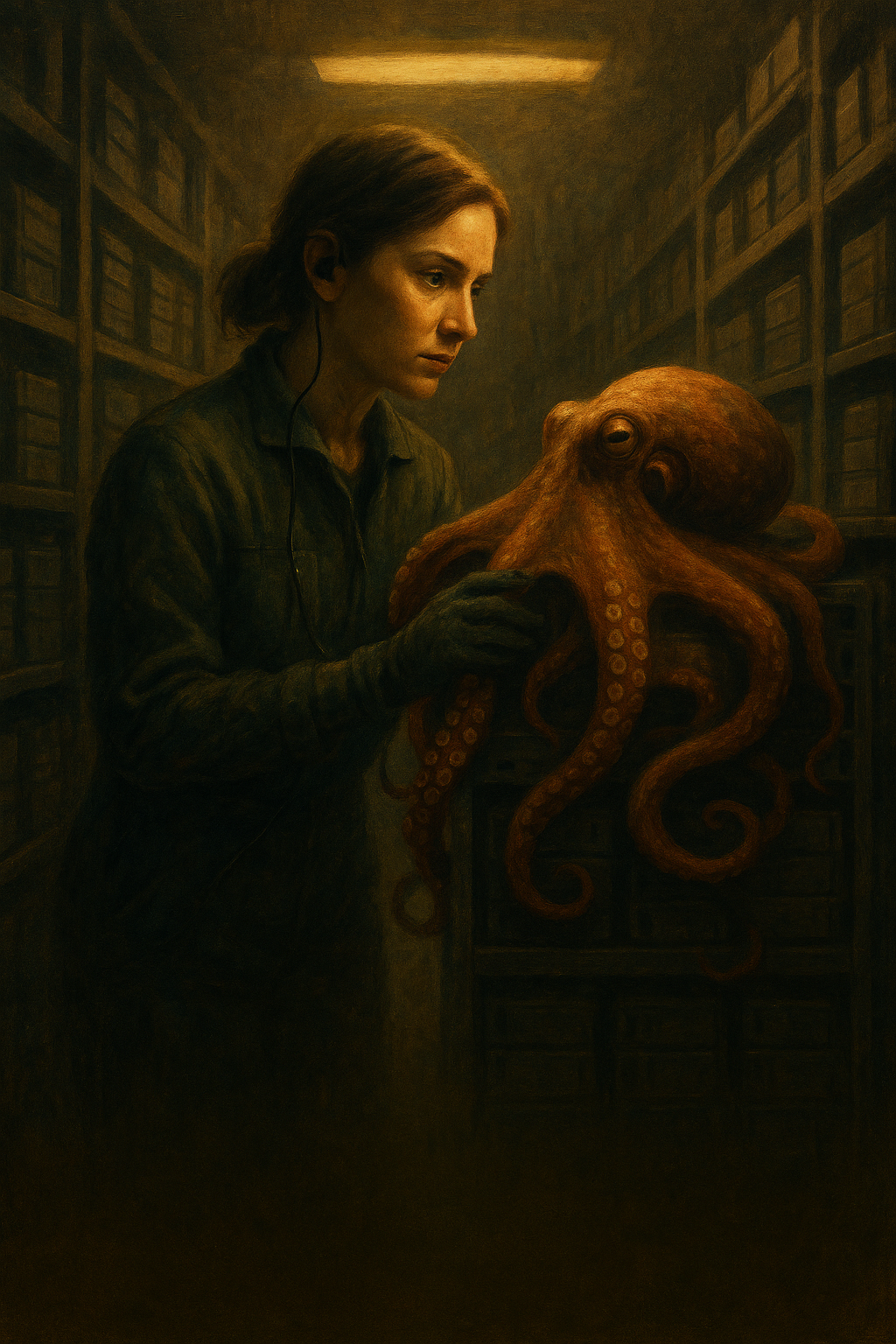
Echoes Beneath the Surface
The fluorescent lights in Bay Three have a hum you stop hearing after a year. Mira Johnson stopped hearing them in 2079. What she hears instead, when she leans over the lip of the bonding tank and adjusts the crown on her temples, is the soft mechanical click of the interface seating itself against bone. Two clicks. Then a third, the safety. The protocol is the same as it has been for ten years and eight months and, if you want to be precise about it, sixteen days. Mira wants to be precise about it. Precision is the thing she brought to this job and the thing the job has given back to her, polished. Below her, in two thousand gallons of filtered Pacific, Ozzy is the color of wet sand. He has been awake for forty minutes. The log will say so. The log says everything.
She lowers herself in. The water at the Marinus Institute is held at fifty-eight degrees, which is colder than comfortable and warmer than the harbor outside the building's foundation walls. The suit handles the rest. What the suit cannot handle, what no suit has yet been engineered to handle, is the moment the interface goes live and the tank stops being a tank. It becomes a room with weather in it.
Mira's breath slows because Ozzy's breath slows. Or the inverse. The directionality of the bond is one of the things the Institute has papers out on and no consensus about. She sees the acropora colony in the western quadrant resolve into something with edges, then past edges, into the particular synthetic branching geometry the engineers spent two years getting right. She sees the filter intake. She sees, with a clarity that is not quite her own eyesight, the faint pressure differential where the current loops back on itself near the eastern wall. And she sees Ozzy seeing her. He comes up off the substrate in a slow unfurling. Amber, pulsing. The chromatophores move in waves that Mira has learned to read the way other people learn to read a partner's face across a kitchen table. Amber means curious. Amber means present. Amber means the dive is good.
She extends a gloved hand. This is the start of the standard sequence. Contact, mirroring, a slow circuit of the tank, then the data sweep and surface. Forty-two minutes, give or take. She has done it one hundred and seventy times with Ozzy and several hundred more with the three subjects who preceded him. Her hand reaches. Ozzy does not. He holds the amber for a half-second longer than the sequence calls for, and then the amber goes. In its place, briefly, deliberately, a deep blue. Not the diffuse blue of a startled cephalopod. A chosen blue. A blue with edges on it. Then he jets.
He moves west, toward the acropora, which is not where the sequence goes. The sequence goes east. The sequence has always gone east. Mira's training, which is considerable, says to follow the subject and log the deviation. Mira's body, which has been doing this for ten years, follows before the training catches up. When she arrives at the coral, Ozzy is already there. This is the part she will think about later, in the locker room, with a towel around her shoulders. He is already there, and his eight arms are spread in a configuration she would describe, if pressed, as presentational. As if he had been waiting. As if she were the one running late. She hangs in the water in front of him. The interface tells her his heart rate is even. Her own is not.
There is a beat in there. She does not know how long. The log will say. The log will say forty-two minutes total dive, within parameters, no flags. The log says everything. She is aware, distantly, that she is supposed to be observing. That the appropriate response to anomalous subject behavior is documentation. She reaches, instead, toward one of the spread arms, and she thinks she touches it, and then the dive is folding up around her the way these things do at the end, the room becoming a tank again, the weather becoming water. She surfaces. The fluorescent hum comes back first. It always does. She pulls herself up onto the deck and sits for a moment on the cold steel with her legs still in the water, and she works the crown off her head with both hands. Two clicks in reverse. The safety, then the seat.
She sets the crown on the towel beside her. She reaches for the towel. On the inside of her left wrist, just above the cuff of the suit where the seal has been peeled back, there is a mark. Circular. Precise. The diameter of a nickel, maybe smaller. The skin around it is faintly pink, the way skin is when something has been pressed against it firmly and recently and then released. It is warm. She looks at it for a while. She is a person who, professionally, does not speculate. She catalogs. She catalogs the mark: location, size, temperature relative to surrounding tissue, presumed mechanism. The presumed mechanism is obvious. The presumed mechanism is in the tank behind her, sand-colored again, drifting near the eastern wall as if the western quadrant had never happened. The part she cannot catalog is that she does not remember it.
Not the press of the sucker. Not the pull. Not the release. The dive log, when she pulls it up on the deck console with her free hand, shows forty-two minutes, within parameters, no flags. It shows her vitals smooth as glass. Mira sits on the steel with her wrist turned up to the fluorescent light and listens to the hum she stopped hearing in 2079. She has, in the next forty minutes, to file a report. She has not yet decided what it will say.