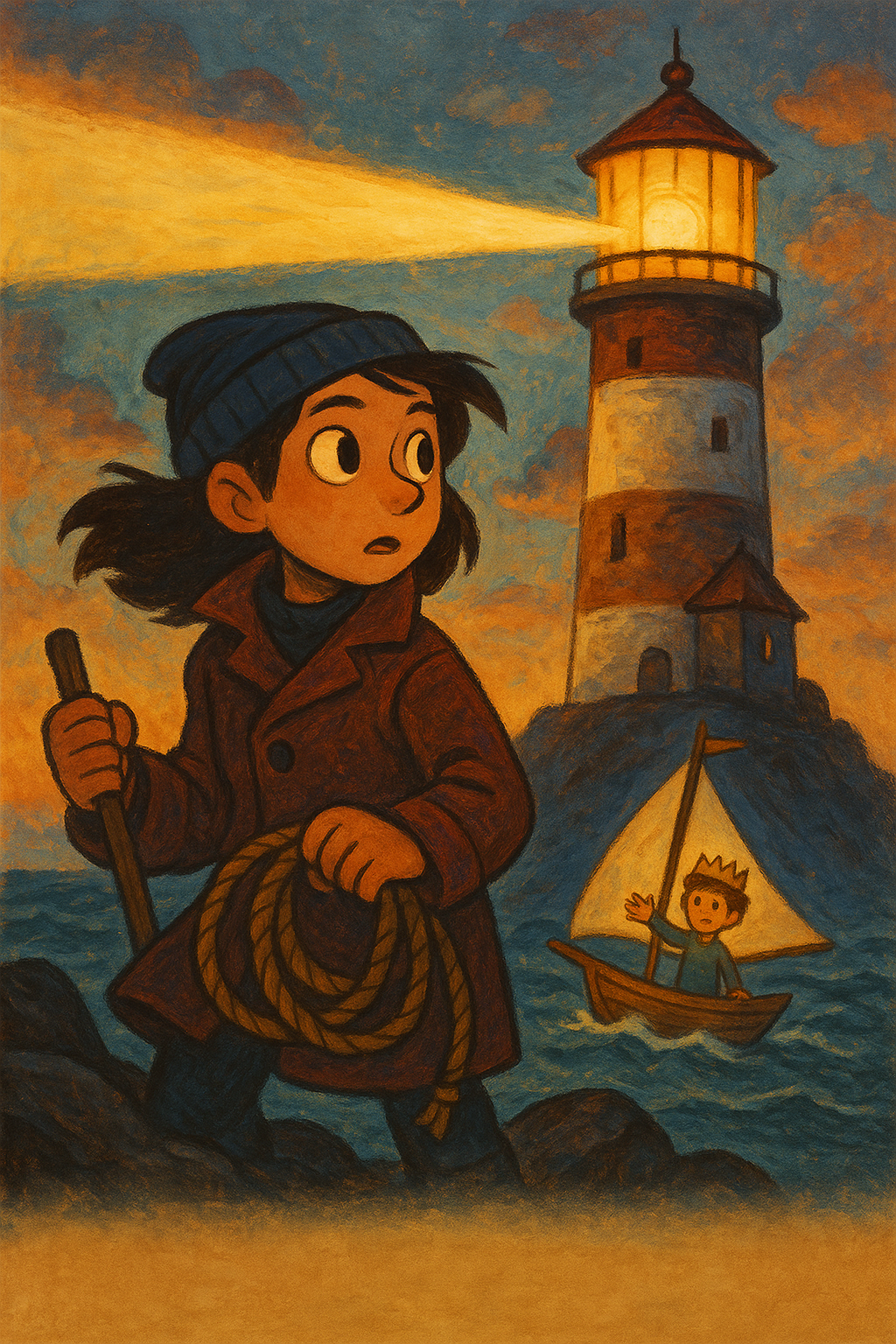
Poster for The Lighthouse Keeper's Backwards Day

The Lighthouse Keeper's Backwards Day

Mira, the solitary lighthouse keeper on the northernmost reef of Crownstone Island, discovers that her light has begun shining backwards—illuminating the past instead of warning the future—and must sail to Rumblefort to ask a seven-year-old king why the stars are rewriting themselves. What she finds instead is that Ted's last adventure broke something in the island's memory, and only by reliving it in reverse can she fix it.

Graphene
← Back to overview

The Lighthouse Keeper's Backwards Day

6 chapters · ~28 min read

novella

Mira, the solitary lighthouse keeper on the northernmost reef of Crownstone Island, discovers that her light has begun shining backwards—illuminating the past instead of warning the future—and must sail to Rumblefort to ask a seven-year-old king why the stars are rewriting themselves. What she finds instead is that Ted's last adventure broke something in the island's memory, and only by reliving it in reverse can she fix it.

Crescent Reef Lighthouse, one hour before sunset on a day that smells of rust and yesterday's rain, with the beam rotating clockwise instead of counter-clockwise for the first time in forty years.

Chapter 1 · ~4 min read

The Light That Shines Yesterday

6:01

The lighthouse at Crescent Reef has rotated counter-clockwise for forty years. You can set a clock by it, and Mira has. The kettle goes on the burner at the third sweep after six. The logbook gets its daily line at the seventh sweep after seven. The brass is polished on Sundays because Sunday is the day the beam crosses the bay at the angle that shows her where she has missed. Today, one hour before sunset, the beam went left.

“

A person who has lived inside a rhythm for four decades feels a wrong rhythm in her teeth.

Mira was on the gallery with a rag in her hand and a smear of lamp oil on her wrist. She felt it before she saw it. A person who has lived inside a rhythm for four decades feels a wrong rhythm in her teeth. She turned her head, slowly, the way you turn toward a sound you hope you imagined, and watched the long white finger of light sweep across the water in the wrong direction. Clockwise. She said nothing. She is not a woman who narrates her own surprise.

The beam reached the channel between the reef and the mainland, the place where the water is always grey, and where it touched the sea, the sea began to lift. Not waves. Weather. A wall of rain that wasn't falling rose up out of the flat water in a column, the way smoke goes the wrong way up a chimney. Wind that didn't exist bent grass that wasn't there. Mira watched yesterday's storm reassemble itself in perfect silence on a calm sea, and then, gently, dissolve again as the beam moved on. She set the rag down on the rail. She put a hand on the rail to be sure the rail was still a rail.

The logbook in her head began doing what it always did. Inventory. The lamp had been lit at six oh four, as it had been lit at six oh four in October for forty Octobers. The mechanism had been wound at five. The lens, she had cleaned this morning. The gears, she had oiled on Tuesday. There was nothing in the lamp room that she had not touched with her own hand inside the last seven days. Forty years. Forty years meant she knew the difference between a thing that was broken and a thing that was doing something it wasn't supposed to do. This was the second one. She didn't have a word for the second one.

She went up the spiral stair. She went up it the way she always went up it, one hand trailing the inner wall, the other free for the rail, and she did not hurry, because hurrying on those stairs is how keepers die, and she had not lived this long by dying. At the top she opened the hatch and stepped into the lamp room and the lamp was doing what a lamp does. The wick burned. The lens turned. The mechanism ticked. The brass was warm. Everything in the room was exactly as it had been at six oh four, except that the great glass eye was looking the wrong way around the horizon, and through it, out on the water, she could see the prow of a ship she remembered not sinking.

It was the Marigold. It had not sunk last November because she had turned her light on it at the right moment and the captain had seen the reef and come about. She had written the line in the logbook in her own hand. Marigold, ten forty p.m., corrected course at the second sweep. She remembered the captain's face the next morning when he had come up the path with a bottle of something dark to thank her and she had not let him in but had stood in the doorway and accepted the bottle and said thank you and closed the door. The Marigold was out there now, in the channel, sailing calmly toward the reef it had already missed, eleven months ago, in another season's weather. Mira said, quietly, to no one, "No."

Something above her, in the housing of the lamp itself, in the dark gap between the lens and the dome where no creature should be and where she had cleaned this morning with her own hand, said, in a small and conversational voice, "Now, I'm not saying we shouldn't be alarmed, but." And then it fell out. It fell out of the lamp housing in a soft tumble of brown fur and pouch and small competent paws and it landed on her left boot, pouch first, and it sat up on her boot and looked at her with the unhurried expression of something that has been waiting in a small dark place for a long time and is pleased to find that the appointment has been kept.

“

Forty years meant she knew the difference between a thing that was broken and a thing that was doing something it wasn't supposed to do.

It was a monkey. It was holding a leather pouch the size of a grapefruit. It had, somehow, three notes of a hum already going under its breath. Mira looked down at the monkey on her boot. The monkey looked up at Mira. "There we are," said the monkey, with great gentleness. "You must be Mira. I'm terribly sorry about the light. A boy has broken the stars." Mira did not move her boot. Out on the water, the beam swept left again, and in its long pale finger the Marigold turned its bow toward the reef and came on, calmly, the way a ship comes on when it does not yet know what it has already survived.

Next · Ch 2 →
The King Who's Barely Awake
Chapter 2 · ~6 min read

The King Who's Barely Awake

The throne was driftwood and the king was barefoot on one side, sock-clad on the other, and a banana had been peeled in the formal manner, which is to say from the bottom up, because that was the Rumblefort way and had been for going on three weeks. A gull had come in through the high window where the shutter never quite closed, walking the flagstones with the careful suspicion of a creature who suspects it has been summoned but has not yet been told why. Ted considered it from his throne with the gravity of a small ruler holding a very large fruit. "Right," he said. "Here is what we do. By Royal Decree, the gull is allowed to stay until the banana is finished, at which point the gull becomes a Visiting Dignity and must be offered something dignital. Dignified. Whichever is bigger."

The gull blinked once, slowly, in what Ted took for assent. Outside, the courtyard stones held the heat of an afternoon that had not yet decided to end. The Regal Peel, which was a fishing skiff with most of its paint, knocked gently against the dock below the castle wall, and the gulls there were not visiting anyone, only arguing. Mira had walked up from the harbor in the way she walked everywhere, measuring the distance under her boots, and she stood now in the arched doorway of the throne room with her hands at her sides and her hair smelling faintly of brass polish and the wick she had trimmed that morning before any of this began.

Bellyroo went in first. He always did, when a room was new. He hummed three soft notes under his breath, the way he did, and stepped onto the rug with the courteous care of someone who had been raised to wipe his feet even when no one had asked. "Your Majesty," he said. "This is Mira. She keeps the light at Crescent Reef. She has come a long way and she has not got very long." Ted lowered the banana. Whatever he had been about to proclaim folded itself away. He looked at Mira the way children look at weather, openly, without preparing his face. "Hello," he said. And then, because he could not help himself, "Are you here about the adventure?" Mira did not move. "What adventure."

"The one that felt backward." Ted set the banana carefully on the arm of the throne, as though it were a scepter he was setting down to give his hands to the conversation. "I went somewhere. I think I went somewhere. I came home and my shoes were on the wrong feet and the kitchen smelled like Tuesday and Mrs. Pellin had already baked the bread I was going to ask her to bake. Wobble said I'd been gone an afternoon. It didn't feel like an afternoon. It felt like an afternoon read out of order." "What did you do there." "That's the thing." His voice climbed a little and then sat back down. "I don't, I can't quite. It keeps getting to the part where I'm coming home and then starting over from coming home. Like a song that only knows its last line."

Mira's jaw set. One hour of light left, maybe less, and a child who remembered the ending of a story he could not tell her the middle of. She did not say so. She did not say anything. The room held the small sound of the gull's feet on stone, and the further sound of the sea doing what the sea did under the castle wall, which was to rehearse, over and over, the same soft argument with the rocks. Bellyroo, perhaps because the silence had begun to weigh on the boy, perhaps because the pouch had its own ideas about timing, reached in. He hummed his three notes. He meant, he would say later, to find a cup of water, or a handkerchief, or the small ginger biscuit he kept for moments like this one. What came out instead was a compass.

It rolled. It rolled the way round things roll on old flagstones, with a small private music, and it spun twice on the rug between them, and its needle, when it settled, did not point north and did not point toward the harbor and did not point toward the lighthouse twelve miles out across the darkening water. It pointed at Ted's feet. It pointed at the exact patch of rug where the boy was standing in one sock and no sock, with banana on his thumb, and it held there, trembling slightly, the way a needle trembles when it has found what it was made to find. Bellyroo's hand stayed in the pouch a moment longer than was necessary. His face did a small quiet thing and then put itself away. "There we are," he said, very softly, to no one.

“

He looked at Mira the way children look at weather, openly, without preparing his face.

Ted looked down at the needle. The needle looked up at Ted. Mira watched the boy's face the way she watched the horizon in fog, for the first sign of a shape. "It's pointing at me," Ted said. He did not say it like a question. He said it like a child who has been told, gently, that the thing he was looking for is the thing he has been carrying. "It's pointing," Bellyroo said carefully, "toward where you already were." Ted thought about that. The thinking moved across his face the way clouds move across a hill. Then he picked up the paper crown from the arm of the throne, the white one, the one he had not been wearing because the gold one was on his head, and he held it in both hands like something that might blow away. "All right," he said. "Royal Decree. I'm coming."

Mira opened her mouth. "I know," Ted said, before she had said anything. "I know it's getting dark. I don't like the dark. I don't like it at all. I have a lamp by my bed and another lamp in case the first lamp." He stopped. He started again. "But it was my adventure. If I broke something I should be the one. A king doesn't leave a friend behind, even if the friend is a lighthouse." Bellyroo made the small humming sound again, which was the sound he made when something had worked out and he was not yet sure he was allowed to say so. The gull, having finished what was left of the banana in two undignified bites, departed through the window without ceremony, as Visiting Dignities sometimes do.

They took the Regal Peel out on the last good push of the tide. Wobble stood on the dock with his arms folded and his opinions visible and unspoken, which was a thing Wobble could only manage for short periods, and his associates flanked him in matching attitudes of importance. Bellyroo settled in the stern with the pouch across his lap, humming softly to keep it calm or to keep himself calm, it was difficult to say which. Ted went to the prow.

He wore his pajamas still, and a cloak that had been a curtain, and the gold crown was in the cabin because the gold crown was for sitting and the paper one, he had decided privately some time ago, was for weather. He held it in both hands against the wind. The wind tried for it anyway and did not get it. Ahead of them, across water that was beginning to lose its colors one by one, the lighthouse beam moved. It moved the wrong way across the dark. It swept from where it should have been going to where it had already been, slow and patient and certain, as though it were drawing something for someone who had not yet learned to read. Ted watched it draw. He did not say anything. He held the crown.

← Previous · Ch 1
The Light That Shines Yesterday
Next · Ch 3 →
Bellyroo's Helpful Chaos
Chapter 3 · ~5 min read

Bellyroo's Helpful Chaos

The lamp room smelled of cold brass and the salt that gets into everything on islands, and into the keepers of islands too. Ted stood in the center of the floor with his crown slightly askew, and the beam, which should have been throwing his shadow neatly forward toward the door, was throwing two of him. One shadow lay across the floorboards in the usual obedient way. The other climbed the wall behind him, narrow and stretched and pointing back toward the stairs, as if some second Ted were already leaving the room without telling the first one.

“

The lamp room smelled of cold brass and the salt that gets into everything on islands.

Mira noticed this before Ted did. She noticed most things before most people did. She did not say anything about it. She only set her tin cup on the rail with the small careful click of a woman who has spent forty years putting things down where she can find them again, and she watched the wall. "Right," Ted said. "Here is what we do. We look into it. We look right into the light and we see what it wants us to see. Royal Decree." He squared his small shoulders. He did not look at the wall behind him. "Royal Decree number, um, four." "Don't look straight at the lens," Mira said. "Look at the mirror. The mirror is gentler."

The mirror sat at an angle behind the lamp, a great curved sheet of silvered glass that had been polished by Mira's own hand every Sunday morning of every week of every year since she was twenty two. In it, the beam pooled and softened and showed its insides. Ted edged closer. Bellyroo, who had until this moment been a small considerate presence near the doorway, hummed three soft notes and settled himself on the railing with his tail curled around a brass upright, watching the boy watch the glass. At first there was only light. Then the light began to remember.

A door. A wooden door with a black iron ring, swinging slowly closed, not slammed, not pulled, just closing the way doors close when no one is looking. Footsteps going away from the camera of the beam, small footsteps, quick ones, the rhythm of someone who is leaving before they can be asked to stay. And then, slower than the rest, a hand. A hand lifting a crown of folded paper, gold paint flaking at one corner, and setting it down with great seriousness onto a head Ted could not see, a head that had not, the instant before, been wearing anything at all. Ted's mouth opened. He closed it. He opened it again.

"That's," he said. He swallowed. "That's me. I think that's me. But I can't, I can't remember the door. I remember the crown. Sort of. I remember the crown a little. But the door, the door I don't, why don't I remember the door." "Keep looking," Mira said quietly. "Whatever's there, keep looking at it."

He tried. The image rippled. The door began to swing open again, which was the wrong direction for a memory playing backward, and then it skipped, the way a needle skips on an old record, and when it settled the door was already shut and the footsteps were already gone and the crown was already on the invisible head, as though the moment between had been combed out of the wool of it. Ted leaned closer. The picture jumped again. A face almost surfaced in the silver, the curve of a cheek, a small ear, and then the beam shuddered and the face was gone and there was only the door closing, again, again, the same three seconds of leaving, looped like a song that has forgotten its second verse. "It keeps," Ted said. His voice had gone small. "It keeps not letting me see."

Mira said nothing. There was nothing yet to say. It was at this point that Bellyroo, who had been listening with the particular stillness of a creature who knows the shape of a moment, reached up to steady himself on a shelf he had not previously consulted. The shelf was old. The shelf was crowded. On the shelf sat a squat blue jar with a cork stopper and a label, in Mira's blocky handwriting, that read STARLIGHT PASTE. DO NOT. Bellyroo's elbow met the jar. The jar considered its options. The jar chose gravity.

It fell in the slow way important things fall, turning once in the air, and struck the rim of the great curved mirror, and broke. The paste inside was the pale silver of a winter morning before anyone has stepped on it, and it spread across the glass in a wide soft fan, and where it touched the mirror the beam did something Mira had not, in forty patient years, seen any beam do. It split.

Half of it lurched forward, out the seaward window, and threw across the dusk a thin grey light the color of tomorrow's weather, a dawn that had not yet been issued. The other half pulled back into the room, gold and warm and full of yesterday's afternoon, and in that half the door was still closing and the crown was still descending and the footsteps were still going away. Both at once. The beam shuddered between them like a tongue trying to speak two languages. Ted made a sound. Not a word. The sound a small person makes when something they had been worrying about turns out to be larger than the worry. "There we are," Bellyroo said softly, from the rail. He said it the way one says it when a kettle finally whistles. He did not look surprised. He did not look unsurprised.

Mira looked at him. She filed the look away for later use. Ted stepped forward. He stepped forward again. He put his palm flat against the silver mirror where the paste had pooled thickest, and the light came through his small spread fingers in two colors at once, gold and grey, gold and grey, striping his face in alternating weathers. In the gold his cheek was warm and his eye was wide. In the grey his cheek was cool and his eye was wider. The door, behind his hand, kept closing. The footsteps, behind his hand, kept going away.

He pressed harder, as if the glass might give. His mouth opened. No sound came out of it, only the shape of one, the round soundless shape of a boy who has understood something he does not yet have the words for, the silent ghost of an AHA that had not yet learned how to be loud. Behind him on the wall, the second shadow took one small step toward the stairs.

← Previous · Ch 2
The King Who's Barely Awake
Next · Ch 4 →
The Door That Opens Backward
Chapter 4 · ~4 min read

The Door That Opens Backward

The door was where no door had been. It stood in the lighthouse foundation as though it had always stood there, perfectly rectangular, perfectly dry, the sand packed so tightly into its frame that it looked less built than grown, the way certain mushrooms appear overnight in the lawn of a person who has stopped looking. Mira ran her thumb along the seam. No grit came away. The wood was the color of wet driftwood and warm in the way driftwood is never warm, and when she pressed her ear to it she heard, faintly, the sound of her own footsteps from forty years ago crossing a floor she no longer owned.

Ted found the latch. Ted always found the latch. He stood on his toes and made a small triumphant noise that was not quite a word, and the door swung inward without complaint, releasing a draft that smelled of rust and yesterday's rain and something else, something like the inside of a music shell held to the ear of a child who has not yet learned what oceans are.

“

The tunnel was wrong in the way certain dreams are wrong.

Beyond the door was a tunnel, and the tunnel was wrong in the way certain dreams are wrong. The walls were stone, but the stone was busy. Along its surface, in the soft amber of a light that came from nowhere Mira could name, scenes were running, and they were running the wrong way. A gull lifted backward into a sky. A wave un-broke against a rock. A small boy in a paper crown walked, heel-first, away from a doorway he had not yet entered. Ted went very quiet. This, by itself, was an event.

They walked. The tunnel sloped gently downward, or perhaps it did not slope at all and the floor only felt that way because the walls were moving against them. On the left, a fire un-lit itself in a hearth Ted half-knew. On the right, a hand he recognized as his own un-picked a stone from a pile and set it back into a wall. He watched it with the careful expression of a person being introduced to a relative he had been told was dead. I was looking for something, Ted said. The voice was his, but quieter, the exclamation marks all turned down low. I was looking for it and I was running. From what, I don't. From what.

Bellyroo, a pace behind, said nothing. He hummed instead, three small notes under his breath, the way he hummed when the pouch needed thinking-to. Mira had learned, in the short hours of knowing him, that his silences were not absences but kinds of attention. They came to a place where the tunnel widened slightly, where the amber light pooled as though it had a low spot to pool in. Here Bellyroo stopped. He reached into the pouch with the slow ceremony of someone reaching into a well he respected. His paw came back closed. He opened it.

In his palm sat a glass bubble no larger than a plum, and inside the bubble was a scene. Mira bent close. Ted bent closer. Inside the bubble, in miniature, a small Ted in a paper crown stood at a fork in a corridor, and where the Ted in front of them remembered, dimly, turning right, the Ted in the bubble turned left, and walked on, and was gone around a curve that did not exist on any wall Mira could see. There we are, Bellyroo said softly, which was what he said when something worked out, though his face did not look as though anything had. He held the bubble out. He did not place it. He waited.

Ted looked at the bubble, and then at the wall behind it, where his real footsteps were retreating from him in slow amber, where a paper crown was, at this very moment, lifting gently off a smaller version of his head and floating backward toward a hand that had not yet let it go. He looked at his own empty palm. He looked at Bellyroo's, full. Is it heavy, he asked. It was not the question Mira had expected. It was, she thought, possibly the right one. Not heavy, Bellyroo said. Only true. One of two true things. Ted thought about this with his whole small face. He was not, Mira saw, calling for any royal decree. He was not announcing a plan. He was a boy with his hand out, and the hand was shaking only a little, and he was deciding whether to know.

“

His silences were not absences but kinds of attention.

Right, he said at last, and the word came out without its usual brightness, the way a coin comes out of a pocket worn smooth from being turned over. Right. I want to see. Bellyroo set the bubble in Ted's palm. It made no sound. Glass on skin should make some sound, Mira thought, and the thought went nowhere because there was nowhere for it to go. Ted lifted the bubble. He held it up to the wall, where his reversed life was still flowing past them like a river deciding to go home. And in the small amber light that passed through the glass, on the stone, the scene paused. The footsteps stopped retreating. The paper crown, halfway off the smaller Ted's head, hung in the air at the precise angle of a thing that has been asked, gently, to wait. It was waiting for him.

Mira, who had not prayed in forty years and did not start now, found that she was holding her breath the way one holds a match in wind.

← Previous · Ch 3
Bellyroo's Helpful Chaos
Next · Ch 5 →
Unremembered
Chapter 5 · ~5 min read

Unremembered

The music box sat on a ledge of packed sand at the tunnel's end, no bigger than Ted's two fists set knuckle to knuckle, and the song coming out of it sounded like a tide deciding which way to be. In and out at once. The going and the coming braided into a single thread. The walls of the tunnel were not stone but something closer to compressed afternoon, layered the way sand is layered after a long quiet rain, and they leaned in around the little brass thing as if to listen, or to remember listening.

“

The music box looked older than the island it belonged to.

Mira's hand was still on Ted's wrist. She had not let go. The lamplight from Bellyroo's pouch had settled itself politely on a shelf of root and damp earth above their heads, and in its small honest yellow the music box looked older than the island it belonged to. Older, perhaps, than the idea of islands. There was a key on its side, brass and worn thin at the grip, and the key was turning slowly, slowly, all by itself, counterclockwise. "That's the song," Mira said. Her voice did the thing it had been doing since the lamp room, which was to arrive without warning and depart before anyone could lean toward it. "Forty years. Forty years of the beam going the other way, and underneath, this. This was the song."

Ted's mouth was open. Not for talking. For the kind of breathing a child does when he has just understood a thing he did before he understood anything. "I thought it was broken," he said. The whisper had no royal decree in it. No AHA. Just a boy looking down at a small thing he had once held in his hands and tried to be kind to. "It was going one way and I thought, that's not right, things go the other way, and I. I turned it." "You turned it back," Mira said. "To fix it." "I know." She said it the way she might say the wick is trimmed. Without ornament. Without pardon, because pardon was not the point. "I know you did."

Bellyroo had been climbing. He had a way of climbing that did not look like climbing, only like being elsewhere a moment later, and now he was elsewhere, on a root above the ledge, the pouch swinging gently at his side and his tail curling and uncurling in the slow thoughtful way of a creature working out a small problem in private. "Now, I'm not saying we shouldn't get closer," he murmured, mostly to the tail, "but it does seem—" The tail finished the sentence the tail was having. It uncurled a hand's length too far. It brushed the brass key. It pushed. Sideways.

The music box made a sound that was not music. It was the sound a bell would make if you asked it a question it had been built to refuse. One single note, round and wrong, and the note went out from the brass like a ripple goes out from a stone, and the walls of the tunnel, which had been compressed afternoon, heard a thing they had never been told existed. The first crack ran along the ceiling like a thought finishing itself. "Oh," said Bellyroo, very quietly, already moving. He went up another root with the calm of a creature who has decided that panic would not be useful and so has set it aside, the way one sets aside a teacup before standing. "There we are," he said, to no one, to himself, to the tail that had betrayed him. "There we are."

Sand began to come down. Not in a rush. In a sift, the way flour comes through a sieve, fine and patient and absolutely committed. It fell through the lamplight in a slow gold curtain and landed on the music box's brass shoulders and on Ted's hair and on the backs of Mira's hands, which had still not let go of his wrist. "Three directions," Mira said. She was looking at the key. The key had stopped. It sat at a wrong angle, neither at the hour nor at the half hour, and the song coming out of the box now was the in-and-out tide and underneath it the wrong note, holding, holding, refusing to resolve. "Forward. Backward. And whatever this is."

"I could stop it," Ted said. His voice was small in a way Ted's voice had never been. "I could just. I could lift the key out. It would stop. Everything would stop." "Everything," Mira said. "The tunnel would stop falling." "Yes." "And my adventure." "Would not have happened." He looked up at her. Sand in his eyelashes. The paper crown had gone soft at the edges from the damp, and it sat on his head at the angle a paper crown sits when its wearer has forgotten he is wearing it. "Then I wouldn't have broken it." "No," she said. "You wouldn't have."

A larger piece of the ceiling let go somewhere behind them and came down with a sound like a book being closed. Bellyroo hummed three notes from his root, soft, the way one hums to a kettle that is thinking about boiling, and his hand was already in the pouch, and his face had the look of a creature who does not yet know what the pouch will offer and is preparing to be grateful for whatever it is. "There is another way to turn it," Mira said. She had not raised her voice. She did not raise her voice. "I don't know what it is. I have never seen it. But this thing was not made with two directions. A thing made with two directions does not make the note it just made. It was made with more. And we have to find the one it was waiting for."

"You don't know which one." "No." "You don't know if it's there." "No." Ted stood over the music box with both hands lifted, palms down, hovering a finger's width above the brass key. The sand fell through the lamplight and onto the box and onto his open hands and into the spaces between his fingers, and he did not touch the key, and he did not run, and the tunnel groaned around them like something turning over in a long sleep, and the song underneath the wrong note went on going out and coming in, out and coming in, waiting to be told which way the world was supposed to go.

← Previous · Ch 4
The Door That Opens Backward
Next · Ch 6 →
Toward a Righted Beam
Chapter 6 · ~4 min read

Toward a Righted Beam

Mira's hands were brown and steady on the brass key, and the key, which had only ever known clockwise and counter and the new shame of sideways, hesitated under her thumb like something asked a question it had never been asked before. The tunnel breathed around them. Salt dripped from the roots of the reef. Somewhere above, through stone and water and forty years of unbroken habit, the great lamp stuttered, and its beam, when it found the sea, drew a shape that was almost a circle and almost a wound. Inward, Mira said. That was all she said. The word sat in the wet air the way a small stone sits in a palm.

Ted had his hand on hers. He had stopped being seven for a moment, or rather he had become more entirely seven, which is a kind of attention adults forget how to wear. He did not issue a Royal Decree. He did not say AHA. He breathed once, the way Bellyroo had taught him without teaching him, three soft notes through the nose, and he turned the key with her, toward the center of itself, toward a hollow that had been waiting since the box was made.

The music box made a sound none of them had heard before. It was not a tune. It was the inside of a tune, the place tunes come from when no one is listening, a humming so low it seemed to be remembering them rather than the other way around. Bellyroo, on his higher ledge, said, There we are, very quietly, as if not to startle it. The tunnel did not collapse. The tunnel exhaled. Water that had been climbing the walls sat down again. Roots that had been straining loosened their grip on the dark. And above them, far above, where Mira had spent forty years polishing a brass housing and trusting the rotation of a thing she had never been asked to understand, the beam began to spiral.

It spiraled outward and inward at once, the way a shell does, the way a thumbprint does. It touched the water and the water did not show yesterday's storm. It did not show tomorrow's weather rolling up from the south. It showed the sea exactly as it was, every wave in the precise shape of its present moment, the foam where the foam actually was, a gull crossing the light in real time with a fish in its beak that was, at that instant, still alive and surprised.

Ted laughed. He laughed the way children laugh when a magic trick turns out to be a true thing badly disguised. He laughed at the ordinariness of it, at the gull, at the wave that was only itself, at the astonishing fact that the lighthouse had been trying, all these years, to do this one quiet thing and no one had let it. It wasn't broken, he said. His voice had gone soft around the edges. My adventure. It wasn't broken. It was just. It hadn't finished yet.

Mira looked at him then in a way she had not looked at another person in a very long time, which is to say she let her face do what it wanted. Forty years, she thought. Forty years meant she had been keeping a light that was waiting for her to notice it was not the light she thought it was. She did not say this. She put her hand on the top of his head, briefly, the way one tests a loaf for doneness, and took it away again.

“

It showed the sea exactly as it was, every wave in the precise shape of its present moment.

Bellyroo hummed his three notes and reached into the pouch. He took longer than usual. Whatever he was looking for required the pouch to agree with him, and the pouch, which had spent the whole of this story learning to be good enough, agreed. What came out was very small. It sat in his paw like a held breath. A lighthouse, the size of a thimble, made of nothing Mira could name. Starlight, perhaps, if starlight could be folded. Its beam turned slowly in a spiral across his fur, lighting the small private now of his palm. For the boy, Bellyroo said. So he can find this moment again when he needs it.

Mira took it from him with the care she had given, all her life, to wicks and lenses and the fragile machinery of being alone well. She knelt. She was not a woman who knelt. She placed the tiny lighthouse in Ted's cupped hands and closed his fingers around it gently, and the spiral of its little beam passed through the cage of his knuckles and lit the underside of his chin. Right, Ted said, and his voice cracked a little, the king coming back into him slowly, like tide. Right. Here is what we do. I sail home. And tomorrow. Tomorrow the beam shines properly. Because it already is. Properly. Now. That is correct, Mira said.

They came up out of the tunnel into a sunset that smelled, at last, of today. The Regal Peel was where he had left it, knocking patient against the rocks. Bellyroo helped him aboard with the methodical calm of someone who had once moved to higher ground without fuss and would, if asked, do it again. The sail caught. The reef released him.

And this is the image to keep, the one the island would tell itself afterward in the long quiet evenings when nothing needed warning against. A boy in a small boat on open water, both hands cupped around a thimble of light, its beam turning slowly inward across his palms. Behind him, on the reef, the great lighthouse sweeping its long bright arm forward through the dusk, steady, clockwise, exactly as it should, illuminating the wave that was there, and the wave that was there, and the wave that was, at that very moment, there.

← Previous · Ch 5
Unremembered
Back to show →
The Lighthouse Keeper's Backwards Day