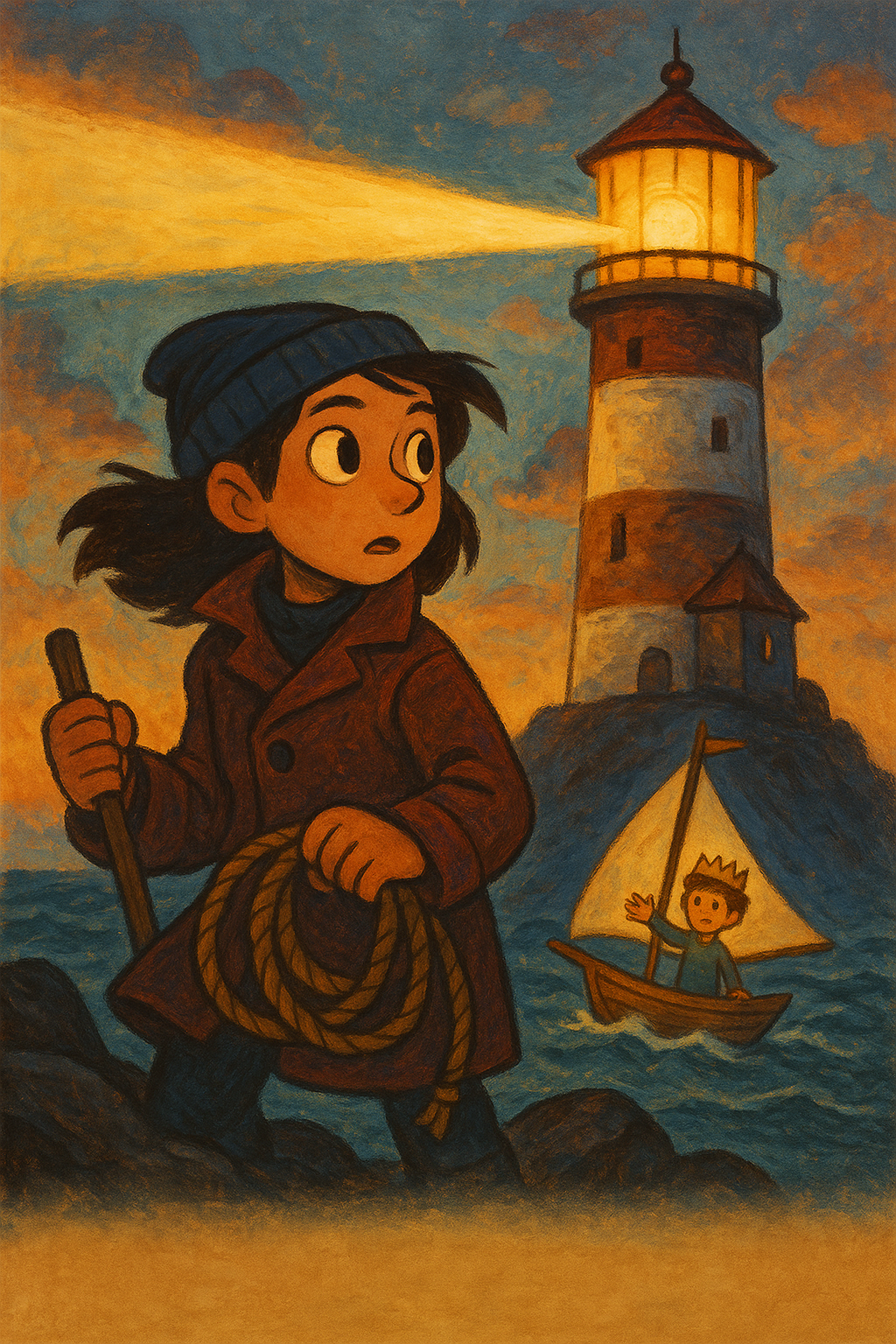
The Light That Shines Yesterday
The lighthouse at Crescent Reef has rotated counter-clockwise for forty years. You can set a clock by it, and Mira has. The kettle goes on the burner at the third sweep after six. The logbook gets its daily line at the seventh sweep after seven. The brass is polished on Sundays because Sunday is the day the beam crosses the bay at the angle that shows her where she has missed. Today, one hour before sunset, the beam went left.
Mira was on the gallery with a rag in her hand and a smear of lamp oil on her wrist. She felt it before she saw it. A person who has lived inside a rhythm for four decades feels a wrong rhythm in her teeth. She turned her head, slowly, the way you turn toward a sound you hope you imagined, and watched the long white finger of light sweep across the water in the wrong direction. Clockwise. She said nothing. She is not a woman who narrates her own surprise.
The beam reached the channel between the reef and the mainland, the place where the water is always grey, and where it touched the sea, the sea began to lift. Not waves. Weather. A wall of rain that wasn't falling rose up out of the flat water in a column, the way smoke goes the wrong way up a chimney. Wind that didn't exist bent grass that wasn't there. Mira watched yesterday's storm reassemble itself in perfect silence on a calm sea, and then, gently, dissolve again as the beam moved on. She set the rag down on the rail. She put a hand on the rail to be sure the rail was still a rail.
The logbook in her head began doing what it always did. Inventory. The lamp had been lit at six oh four, as it had been lit at six oh four in October for forty Octobers. The mechanism had been wound at five. The lens, she had cleaned this morning. The gears, she had oiled on Tuesday. There was nothing in the lamp room that she had not touched with her own hand inside the last seven days. Forty years. Forty years meant she knew the difference between a thing that was broken and a thing that was doing something it wasn't supposed to do. This was the second one. She didn't have a word for the second one.
She went up the spiral stair. She went up it the way she always went up it, one hand trailing the inner wall, the other free for the rail, and she did not hurry, because hurrying on those stairs is how keepers die, and she had not lived this long by dying. At the top she opened the hatch and stepped into the lamp room and the lamp was doing what a lamp does. The wick burned. The lens turned. The mechanism ticked. The brass was warm. Everything in the room was exactly as it had been at six oh four, except that the great glass eye was looking the wrong way around the horizon, and through it, out on the water, she could see the prow of a ship she remembered not sinking.
It was the Marigold. It had not sunk last November because she had turned her light on it at the right moment and the captain had seen the reef and come about. She had written the line in the logbook in her own hand. Marigold, ten forty p.m., corrected course at the second sweep. She remembered the captain's face the next morning when he had come up the path with a bottle of something dark to thank her and she had not let him in but had stood in the doorway and accepted the bottle and said thank you and closed the door. The Marigold was out there now, in the channel, sailing calmly toward the reef it had already missed, eleven months ago, in another season's weather. Mira said, quietly, to no one, "No."
Something above her, in the housing of the lamp itself, in the dark gap between the lens and the dome where no creature should be and where she had cleaned this morning with her own hand, said, in a small and conversational voice, "Now, I'm not saying we shouldn't be alarmed, but." And then it fell out. It fell out of the lamp housing in a soft tumble of brown fur and pouch and small competent paws and it landed on her left boot, pouch first, and it sat up on her boot and looked at her with the unhurried expression of something that has been waiting in a small dark place for a long time and is pleased to find that the appointment has been kept.
It was a monkey. It was holding a leather pouch the size of a grapefruit. It had, somehow, three notes of a hum already going under its breath. Mira looked down at the monkey on her boot. The monkey looked up at Mira. "There we are," said the monkey, with great gentleness. "You must be Mira. I'm terribly sorry about the light. A boy has broken the stars." Mira did not move her boot. Out on the water, the beam swept left again, and in its long pale finger the Marigold turned its bow toward the reef and came on, calmly, the way a ship comes on when it does not yet know what it has already survived.