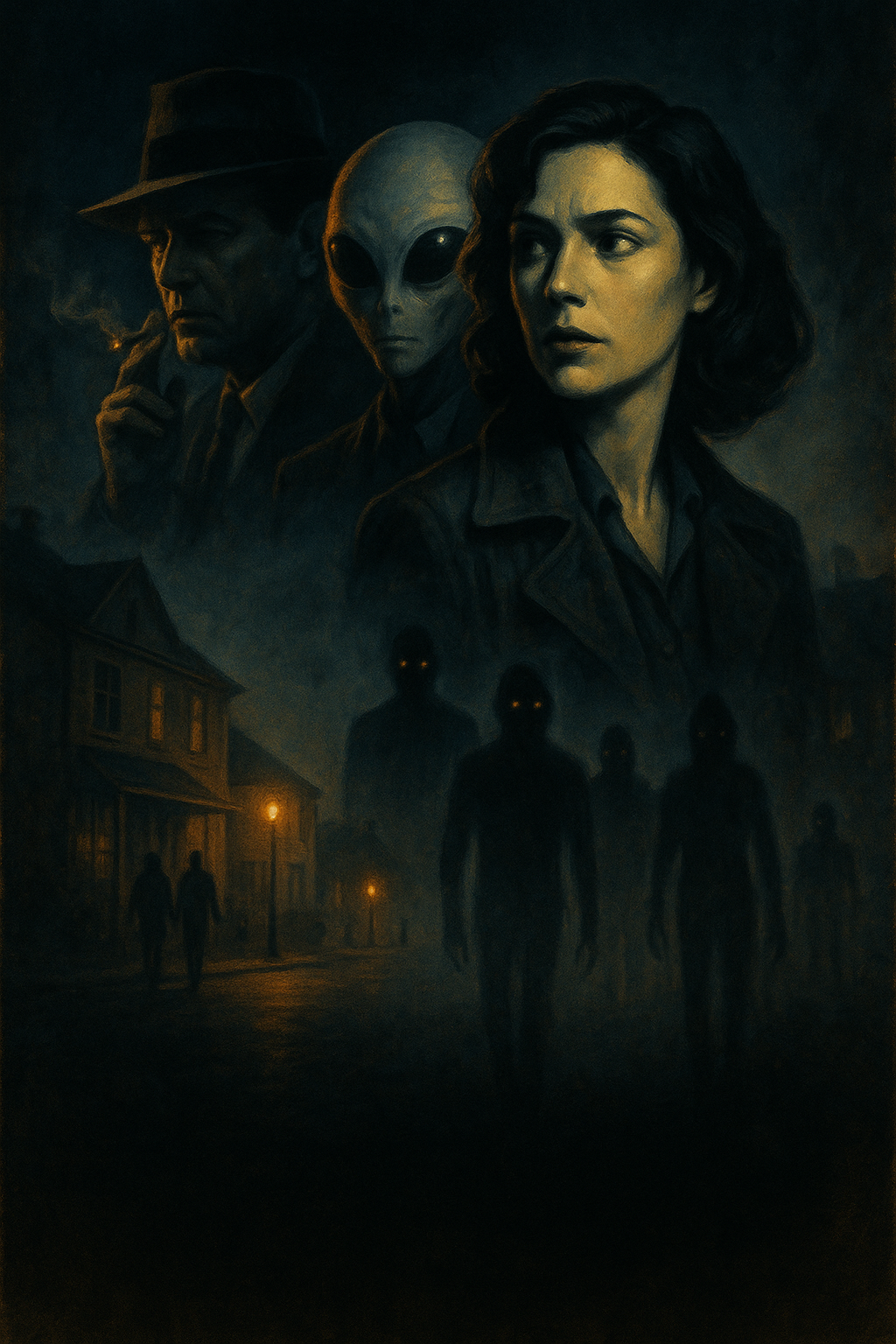
Whispers in the Dark
"I want a name," Marcus said. "One name, one quote, one person willing to say the words on the record. That's the bar." Alex had the phone wedged between shoulder and ear, weaving past a man in a top hat made of what appeared to be taxidermied moths. The connection was bad. The festival was loud in a specific way, the way outdoor crowds get loud, layered, a kind of soft roar you have to shout under even when nobody is shouting at you. "I've been here forty minutes." "Then you have until midnight." "Marcus." "Craft beer tent needs a thousand words by Sunday either way," he said, and hung up.
Alex slid the phone into a jacket pocket and stood for a moment in the middle of the thoroughfare, taking inventory. Three years covering this beat had produced a working theory about crowds like this one, which was that the people who came to festivals with names like the Oddities Festival broke roughly into three camps. There were the costumers, who wanted to be looked at. There were the collectors, who wanted to look. And there was a third, smaller group, harder to spot, who came because something in their life had happened that they could not explain and they were hoping to find, in a field full of hand-forged pendants and cryptid merchandise, some category that would hold it. The third group did not want to be quoted. That was the problem.
Overhead, the amber lights were strung between poles in long swagged rows, and they moved in the wind the way strings of lights move in wind, except when Alex actually watched them they seemed to move a beat slower than the flags did, or a beat faster, something just off enough to notice and not off enough to prove. Alex looked away. That was the trick with this kind of story. You looked away and you kept walking and you found somebody with a name and an email address who would say a sentence you could put between quotation marks.
Alex had already tried four people. A woman selling bone jewelry had laughed and said oh sure, everybody's seen them, and then when Alex produced the recorder she had said, on second thought, no, she personally had not seen anything, she was just repeating what people said. A teenager in a rubber wolf mask had launched into a story involving his cousin and a gas station bathroom and then, at the recorder, remembered he had to find his friends. A man drinking cider from a horn had said, quote, I don't talk to press, and walked away, which was itself a quote Alex could not use. The pattern was starting to interest Alex more than the phenomenon. People wanted to tell the story. They did not want to be the story. There was a threshold there, and every time Alex crossed it the witness stepped back over.
A hand closed on Alex's sleeve. She was small, or she was hunched. The crow mask was pushed up onto her forehead so that the beak jutted skyward like a second face looking at the sky while the first face looked at Alex. Her eyes were doing something Alex did not immediately have a word for. Wide, yes, but also not quite settling, drifting a quarter inch off from wherever Alex's own eyes were. "You feel it?" she said. "I'm sorry?"
She did not repeat the question. She lifted her free hand and pointed, and Alex followed the point past a stall selling pressed-flower tarot cards, to a place where two vendor tents stood shoulder to shoulder with maybe eighteen inches between them. The gap was dark in the way that alleys between buildings are dark, which is to say it should have been, except this was a festival at dusk with amber lights strung right over the top of it, and the light was not going in. Alex noticed, too, that trying to look directly into the gap produced a small, quiet difficulty, a slippage, as though the eye preferred the tents on either side and kept catching on them. "The cold," the woman said. "Do you feel the cold. The way your eyes don't. The way they don't want to." "Can I ask your name?"
Her hand tightened on Alex's sleeve. "Just your first name is fine." Alex reached slowly, the way you reach around a nervous dog, and drew the recorder from an inside pocket. It was small, silver, no bigger than a lighter. Alex had used it for three years. It had recorded a mayor lying and a farmer weeping and a man in Cleveland claiming to have been abducted by a moth. It had never in that time frightened anyone. The woman looked at it. The woman let go of Alex's sleeve. "No," she said, backing away. "No, no, I can't, I'm sorry, I thought, I'm sorry." "Wait."
She was already gone. Not gone in any dramatic sense. Gone the way people go at festivals, which is to say she turned, and the crowd absorbed her, and the crow mask on her forehead was for a second visible above the shoulders of a group in matching cloaks, and then it wasn't. Alex stood in the thoroughfare with the recorder still in one hand, red light on, catching nothing but the general roar. Overhead one of the amber bulbs sputtered, dimmed, held. The wind moved down the row and the lights swayed and the flags snapped and a paper napkin cartwheeled past Alex's boot. On the ground, where the woman had been standing, a single black feather lay in the trampled grass. Alex looked at it for a long moment. The wind kept coming. The napkin was already gone, tumbling toward the beer tent. The feather did not move.
Alex crouched, and did not touch it, and reached instead for the recorder to note the time, and realized the recorder was already running, and had been running the whole time, and would keep running.