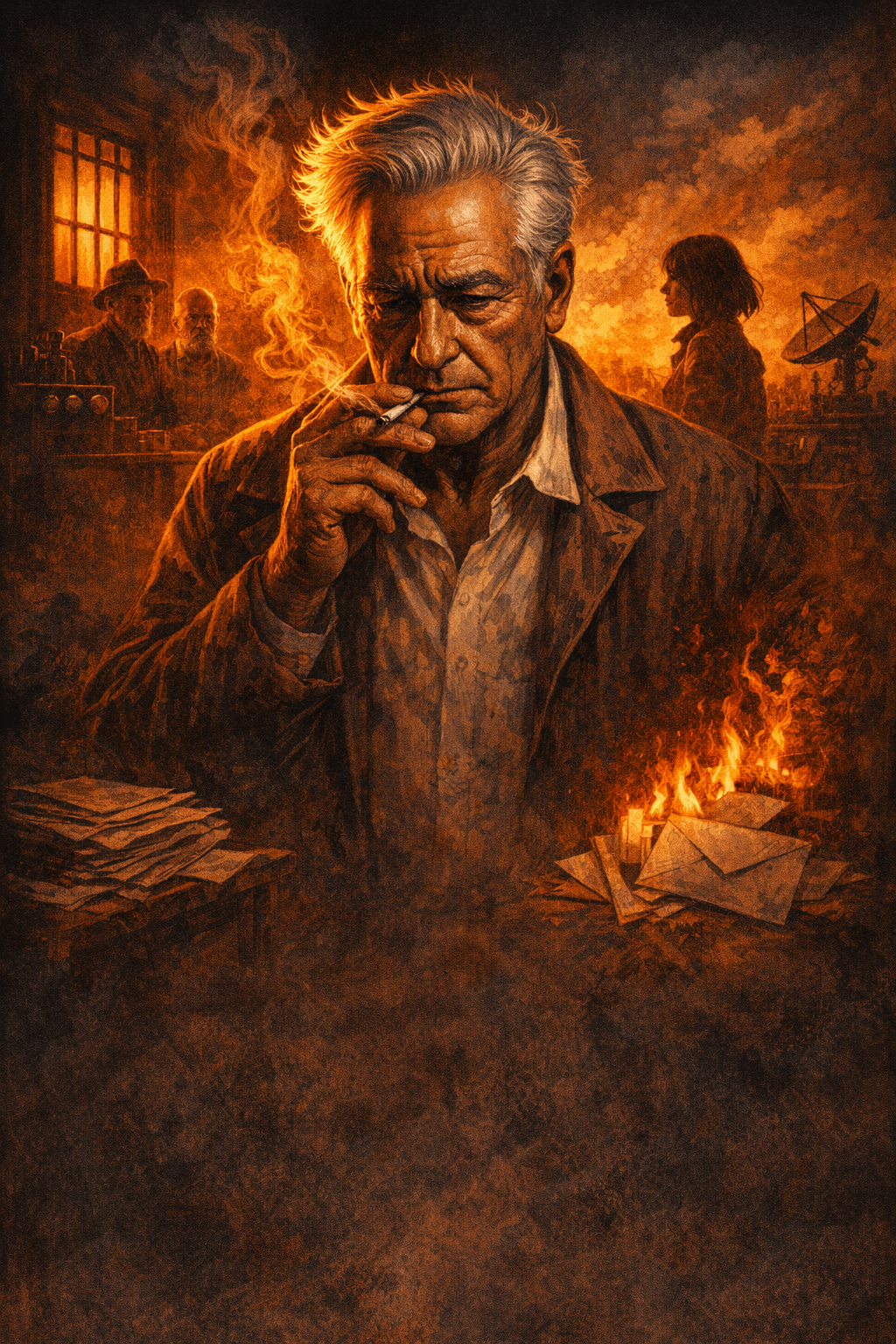
Echoes of a Lost Revolution
The question Clara couldn't put down was whether a man could be two things at once and still deserve a sentence that forgave him either. She turned it over on the drive in. She turned it over on the stairs down into the basement. She was still turning it over when she pushed open the door and saw the box. It sat on a folding table under a single hanging bulb, the kind that swings a little when the furnace kicks on. Inside the box were pamphlets. Hundreds of them. Mimeographed, the ink gone soft purple with age, the top sheet yellowed and curling at its corners like a leaf going back to the tree. ORGONE AND THE LIVING, the top one said. Clara read it twice before she realized nobody had introduced themselves yet. There were six people in the room and all of them were watching her read.
Clara is twenty-six. She has been a journalist for three years and a serious one for about four months, by which she means she has started turning down the assignments her editor hands her and proposing her own. This is the first of those. She had to argue for it. Her editor said nobody remembers Reich anymore and Clara said that was precisely the point, and her editor, who liked her, let her have it on the condition she come back with something. She came back here first.
The woman who had agreed to meet her was named Margarethe, and Margarethe introduced the others by their relationship to the work rather than by occupation. This one studied under him in forty nine. That one typed the later manuscripts. The man by the coffee urn had driven him, once, to a train. They said these things the way people in other basements name the saints. Clara wrote it down and tried not to let her pen betray her. "You've read him," Margarethe said. It wasn't a question. "I've read some." "Which." Clara named three books. She watched Margarethe's face do a small arithmetic and arrive at a cautious sum. "And what do you think."
There was the trap. Clara had rehearsed a neutral answer in the car and the neutral answer evaporated the moment she opened her mouth. What came out instead was that she thought he had been asking the right questions, that she thought the century had not deserved him, that she thought. She stopped. She had used the word brilliant. She heard herself use it and watched Margarethe hear it too, and watched something in the room relax a quarter inch and something else, in Margarethe specifically, tighten. "Everyone comes in admiring him," Margarethe said. "The ones who stay admiring him are the ones who never met him." Clara wrote that down too. Her hand was not quite steady.
She asked about the on-record interview then, because she had been told to ask early and often, and Margarethe said she would think about it, which Clara understood to mean no, not yet, possibly never. Margarethe was leaving the city on Sunday. It was Thursday. Clara had three days to become someone Margarethe could trust and she had already, in the first ten minutes, shown her hand. She stayed another hour. She listened. The man who had driven him to the train described the drive in a kind of hush, as though Reich were asleep in the next room and might wake. Someone else mentioned a trial without naming it. Someone else mentioned a fire without naming that either. Clara noticed how often the sentences stopped before their verbs arrived. These people had been talking around certain things for so long the shapes of the omissions had become furniture.
She was gathering her coat when the old man came over. He was one of the ones who hadn't spoken. He was tall in the way that old tall men are, folded, and he held something between his thumb and forefinger as if it might break if he squeezed or break if he didn't. "Take this," he said. It was a photograph. Small, the size of a playing card, the emulsion cracked across one corner like a windshield. A man in shirtsleeves on a porch, squinting at whoever was holding the camera. Not posed. Caught. "I don't," Clara started. "I shouldn't take this. This is yours." "It isn't," he said. "It was his." She tried to give it back. He put his hands in his coat pockets and stepped away from her, the way you step away from a dog you don't want to feed again.
"You'll know what to do with it," he said. "Or you won't, and then you'll give it to the next one." She wanted to ask what next one. He had already turned toward the coffee. In the car she put the photograph on the passenger seat, face down, because face up it was looking at her and she wasn't ready. She sat with her hands on the wheel. The engine was off. The church loomed in the windshield, brick and unremarkable, the kind of building you drive past for years without seeing. Inside it, six people were folding chairs and stacking pamphlets they would never give away. She did not start the car. Not yet. She was still turning the question over, and now the question had a face.