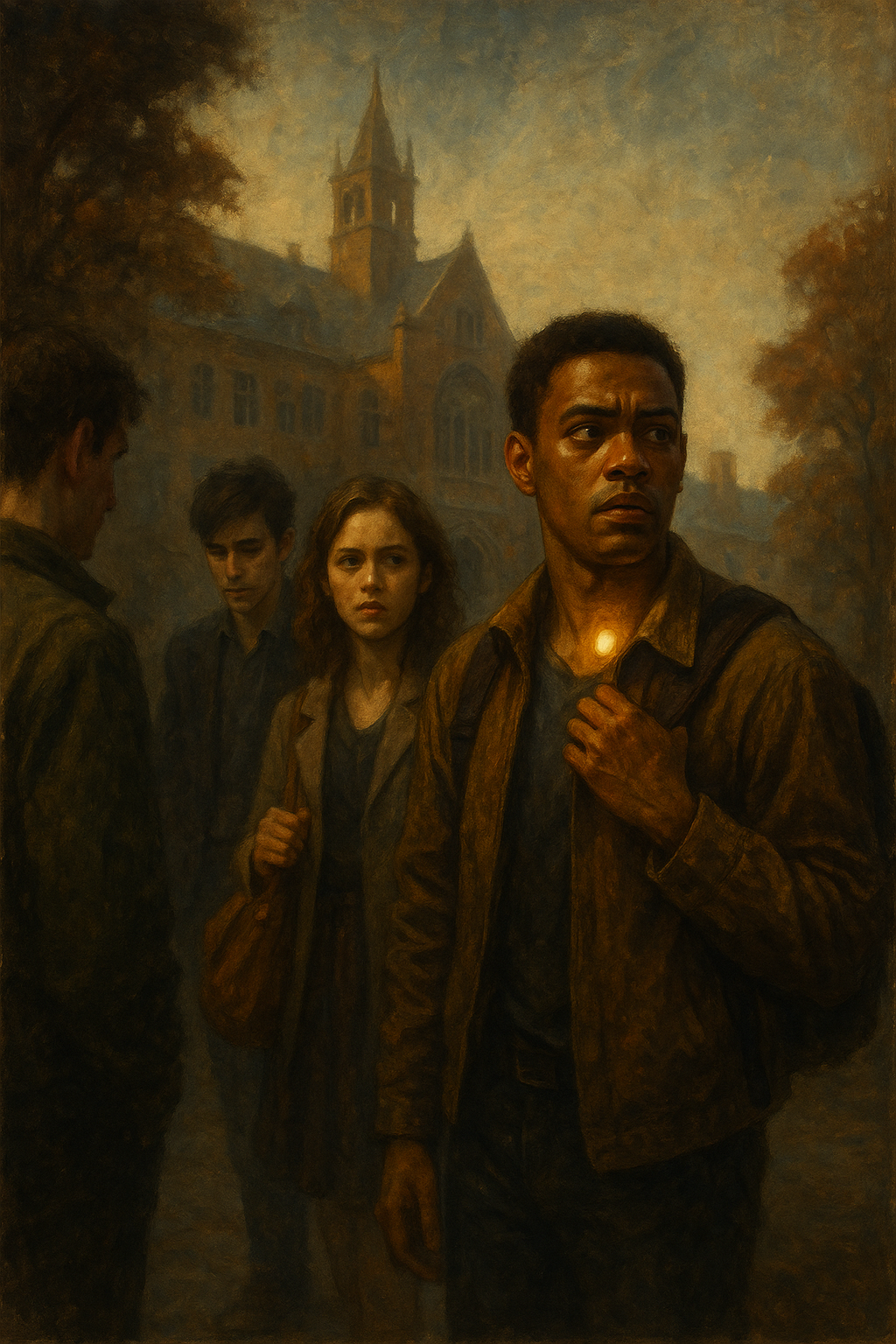
The Light Beneath the Skin
The girl two rows ahead of Leah was wearing a thin cotton shirt the color of skim milk, and through it, just to the left of her spine, something pulsed pale blue. Once every second or so. Not a flicker. A breath. The light moved when the girl moved, settled when she settled, and Leah, who had been told three weeks ago that she should not stare, stared. It was eight minutes past the hour. The seminar room smelled like floor polish and the inside of a thermos. There were forty-one students in attendance, which Leah knew because she had counted them, and then counted them again, and then a third time when the second count did not match. At the front of the room, the facilitator was talking about mice.
His name was Chen. He had a habit of holding his hands flat in front of his sternum when he wanted the room to settle, the way you'd calm a horse. He was saying that in 1968, in a barn somewhere outside Bethesda, a researcher had given a colony of mice everything they could possibly want. Food. Water. Warmth. No predators. Unlimited space, at first, and then enough space, and then space that was merely sufficient. The colony grew. Then the colony curdled. Then the colony ate itself. He said the word resources the way some people say the word God.
Leah pressed her knees together under the desk and concentrated on her breathing, which had begun, around the four-minute mark, to do the thing. The thing was this. Her chest would forget. Then her chest would remember, and overcorrect, and pull in too much air, and she would have to let some of it out in a way that could not be seen from any angle in the room. She had practiced this in mirrors. She had a system. The slide behind Chen changed. It said, in clean sans-serif: TEMPORAL REGULATION: A FRAMEWORK FOR GRADUATES.
Leah swallowed. Swallowed again. Graduates of what, the slide did not say, and Chen did not pause to explain, and nobody in the room raised a hand, because by the second week of the second year you had learned which words were the kind you asked about and which words were the kind you let pass over you like weather. The girl with the light in her back shifted in her seat. The blue moved with her, then steadied. Leah counted the pulses. One. One. One. It was the rhythm of something keeping time.
Chen was saying that the Bureau, which was now the Department, which was now simply the CDA, had spent the better part of two decades asking a single question. If a society is given more than it needs, what does it do with the surplus? And the answer, he said, with the small regretful smile of a man delivering weather, was that it spends the surplus on itself, and then it spends itself. He said the word urgency. He said it twice.
He said that the most precious resource a young person had was not money, and not attention, and not even health. It was the hour in front of them. And that the agency, in its care for cognitive outliers, had developed a tool of clarity. A preventive measure. Something small, he said, and held up his thumb and forefinger to show how small, the way a fisherman lies about a fish. Leah looked at the girl's back. The light pulsed. Pale. Patient. She became aware that her hands were damp. She became aware that the boy beside her, whose name she did not know, had noticed her hands were damp, and had looked away in the careful manner of someone who did not want to be a witness. She put her hands under the desk. She put them on her thighs. She pressed down.
Chen walked along the front row. He did this sometimes during the second half. He would walk, and talk, and his hand would graze the edge of a desk, and the student at that desk would go very still for the rest of the session and leave quickly afterward without speaking to anyone. Leah had seen it happen twice this term. She had told herself both times that she had imagined it. His hand grazed the edge of her desk. He did not look at her. He was looking at the back of the room, at a student who had asked a question last week, and he was answering that question now, several days late, in a voice pitched for the whole room. His hand moved. Something flat and laminated slid across the wood under his palm and came to rest against the inside of her wrist.
She did not look down for a long time. When she did, she saw only six words, printed in the same clean sans-serif as the slide. A recommendation has been made. She did not pick it up. She slid it, slowly, into her lap, and covered it with both hands, and kept her face exactly where it had been, which was tilted three degrees toward the front of the room in an expression of polite attention she had been wearing since she was nine years old. Chen kept talking. He talked for another twenty-two minutes. Leah did not hear any of it. She heard her own breath, and the small wet click in her throat each time she swallowed, and underneath all of it, faintly, as if she had begun to imagine it already, the soft regular pulse of a light that was not yet hers.
The transit car home was almost empty. She took a seat by the window and watched the campus slide backward into the dark. Somewhere behind her, two stops down the line, a boy with a blue glow at the small of his back got off and walked into a street she could not see. Leah pressed her hand flat against her ribs, under her jacket, under her shirt, against the skin. She held it there. She felt her heartbeat through her palm. She felt the heat of her own body, ordinary, unmarked, on loan. She kept her hand there until the next stop, and the next, feeling for a warmth that was not there yet.